

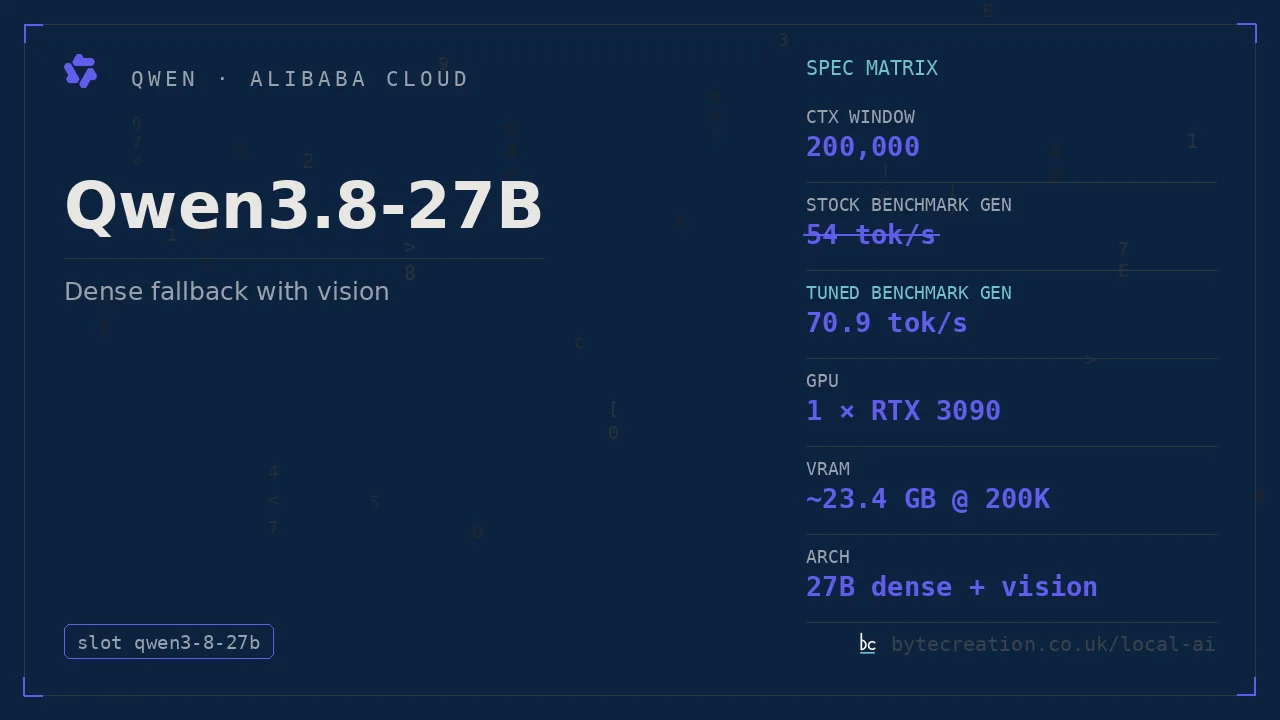
Qwen3.8-27B is the dense representative: 27B with native vision and an embedded MTP head, and an old-timer, first runs here were Ollama defaults at ~54 tok/s.
The interesting part is the tuning case study. The shipped thinking effort (xhigh) caused runaway thinking loops and ~4× wall-time bloat with no quality gain. One registry change, reasoning_effort: medium, thinking-mode sampling, an 8,192-token budget, took measured generation from 42.3 to 72.5 tok/s at 8K (+71.4%), with the thinking staying bounded under budget.
The fix was settings, not hardware: reasoning_effort: medium replaced the shipped xhigh default, which caused runaway thinking loops with no quality gain. Generation rose from 42.3 to 72.5 tok/s at 8K context.
Specifications
| Field | Value |
|---|---|
| Architecture | 27B dense + vision encoder |
| Served by | llama.cpp — the llama-server process behind the orchestrator |
| Weights | Unsloth UD-Q4_K_XL ~17.1 GB + mmproj-Q8_0 ~601 MB |
| Context | 200,000 |
| GPU footprint | Single RTX 3090 |
| VRAM on one RTX 3090 | ~23.4 GB @ 200K |
| Role here | Long-context reasoning + vision |
| Source | Qwen/Qwen3.8-27B · GGUF: unsloth/Qwen3.8-27B-GGUF · mmproj: ggml-org/Qwen3.8-27B-GGUF (Q8_0) |
| KV cache | q4_0 (K and V) |
| MTP | use_mtp: true, mtp_n_max: 2 |
| Sampling (tuned) | temp 1.0 / top_p 0.95 / reasoning_effort: medium / preserve_thinking: true / budget 8,192 |
| Vision | Yes — mmproj forced to CPU; ffmpeg/ffprobe required for decode |
| Tools | Tool calling + attachments |
Benchmarks
| Run | Prompt tok/s | Gen tok/s |
|---|---|---|
| First run here (Ollama default, 4K ctx) | 1,085 | 53.6 |
| Pre-tune @ 8K (v0.7.0) | 444.7 tok/s | 42.3 tok/s |
| Post-tune @ 8K, 256 tokens | 240.4 tok/s | 72.5 tok/s (+71.4%) |
| Post-tune @ 8K, 1024 tokens | 237.8 tok/s | 65.3 tok/s |
| MTP n=2 vs none @ 8K | 173.5 vs 249.6 tok/s | 68.2 vs 38.8 tok/s |
| Orchestrator sweep | 756.8 tok/s | 70.9 tok/s |
Prompt-eval drop after tuning is expected: thinking-mode sampling (1.0/0.95) costs more per forward pass than the old instruct pair (0.7/0.8), the generation gain is the trade.
Stock vs tuned. First run here (Ollama defaults): 53.6 tok/s at 4K. The tuning case study below (thinking-effort fix + MTP) took llama.cpp generation from 42.3 to 72.5 at 8K. The like-for-like 200K sweep shows 70.9. Stock llama.cpp Q4 on a 3090 elsewhere: ~38–42.
Memory & CPU
~23.4 GB VRAM at 200K with the projector on CPU. Per-slot RSS ~1–2 GiB. One 3090.
Build requirements: v0.7.0 + NVIDIA mlock patch, ffmpeg/ffprobe installed, and GGML_CUDA_CUBLAS_COMPUTE_TYPE=fp32 in the systemd environment for Ampere vision stability.
Local config
Verbatim entry from /mnt/data/llama-models/registry.json:
{
  "gguf": "/mnt/data/llama-models/qwen3.8-27b/Qwen3.8-27B-UD-Q4_K_XL.gguf",
  "mmproj": "/mnt/data/llama-models/qwen3.8-27b/mmproj-Qwen3.8-27B-Q8_0.gguf",
  "ctx_size": 200000,
  "gpu_layers": 99,
  "flash_attention": true,
  "cache_type_k": "q4_0",
  "cache_type_v": "q4_0",
  "ubatch": 64,
  "batch": 512,
  "temperature": 1.0,
  "top_p": 0.95,
  "top_k": 20,
  "reasoning": true,
  "reasoning_format": "deepseek",
  "chat_template_kwargs": {
    "enable_thinking": true,
    "reasoning_effort": "medium",
    "preserve_thinking": true
  },
  "fit_gpu": [
    0,
    1
  ],
  "family": "qwen",
  "wide_slot": false,
  "attachment": true,
  "tool_call": true,
  "output_limit": 32768,
  "use_mtp": true,
  "mtp_n_max": 2,
  "reasoning_budget": 8192,
  "image_min_tokens": 1024
}Build it yourself
Hardware. Model runs on 1 x RTX 3090 24G. The projector stays on CPU.
- CPU: AMD Ryzen 9 5900X, 12 cores / 24 threads, Zen 3
- Motherboard: ASUS ROG STRIX X570-E GAMING WIFI II (AM4, ATX)
- GPU: 2× NVIDIA GeForce RTX 3090, 24 GB VRAM each (the model needs one card)
- Total VRAM: 48 GB (2 × 24 GB)
- System RAM: 128 GB DDR4 (~121.5 GiB usable)
- Storage: 2 TB KIOXIA EXCERIA NVMe SSD
- OS: Ubuntu 26.04.1 LTS, headless
- CUDA: toolkit at /usr/local/cuda-13.1
- PCIe topology: both GPUs on the CPU root complex. X8/x8 split when both slots populated (normal for this board); Gen1 at idle → PCIe 4.0 x8 under load. Nvidia-smi topo -m shows PHB between GPUs. No NVLink
- Cooling/chassis: open mining rig (GPU spacing + rig fans, no case). GPU 0 peaks ~73–74 °C under dual load. Routine sw_thermal/sw_power_cap throttle to ~76 °C is normal
- Kernel mitigations in place: pcie_aspm=off, LimitMEMLOCK=infinity, orchestrator MemoryMax=110G
Download.
hf download unsloth/Qwen3.8-27B-GGUF Qwen3.8-27B-UD-Q4_K_XL.gguf
  --local-dir /mnt/data/llama-models/qwen3-8-27b
hf download ggml-org/Qwen3.8-27B-GGUF mmproj-Qwen3.8-27B-Q8_0.gguf
--local-dir /mnt/data/llama-models/qwen3-8-27bThe tuning preset is the payload, external bench evidence (VulcanBench, Veladan and others) says medium ties xhigh on quality at 2–4× the speed. We verified the same effect locally. The 8,192-token budget sits above the productive region: 154/164 HumanEval runs never reached it.
Register & serve. Add an entry to your registry.json (schema in the orchestrator post), restart the service, then smoke-test:
curl -s http://127.0.0.1:8010/v1/chat/completions
  -H "Content-Type: application/json"
-d '{"model":"qwen3.8-27b","messages":[{"role":"user","content":"What is 2+2? Answer with just the number."}],"max_tokens":64}'A correct short answer with no errors means the model is live on the endpoint. Watch GET /health while a slot loads (~20–40 s warm for this size).
Gotchas
- With the stock
xhigheffort, expect 20K–80K-token thinking loops, the single biggest performance trap in this registry. - Without
GGML_CUDA_CUBLAS_COMPUTE_TYPE=fp32on RTX 30-series, vision outputs degrade (Ampere cuBLAS precision). - Vision image decode needs ffmpeg/ffprobe present, silent failures otherwise.
- Content responses come with empty
content+ populatedreasoning_contentwhen thinking dominates, clients should read both fields.
Links. Model card · Unsloth GGUF · mmproj (ggml-org) · Apache-2.0 licence