

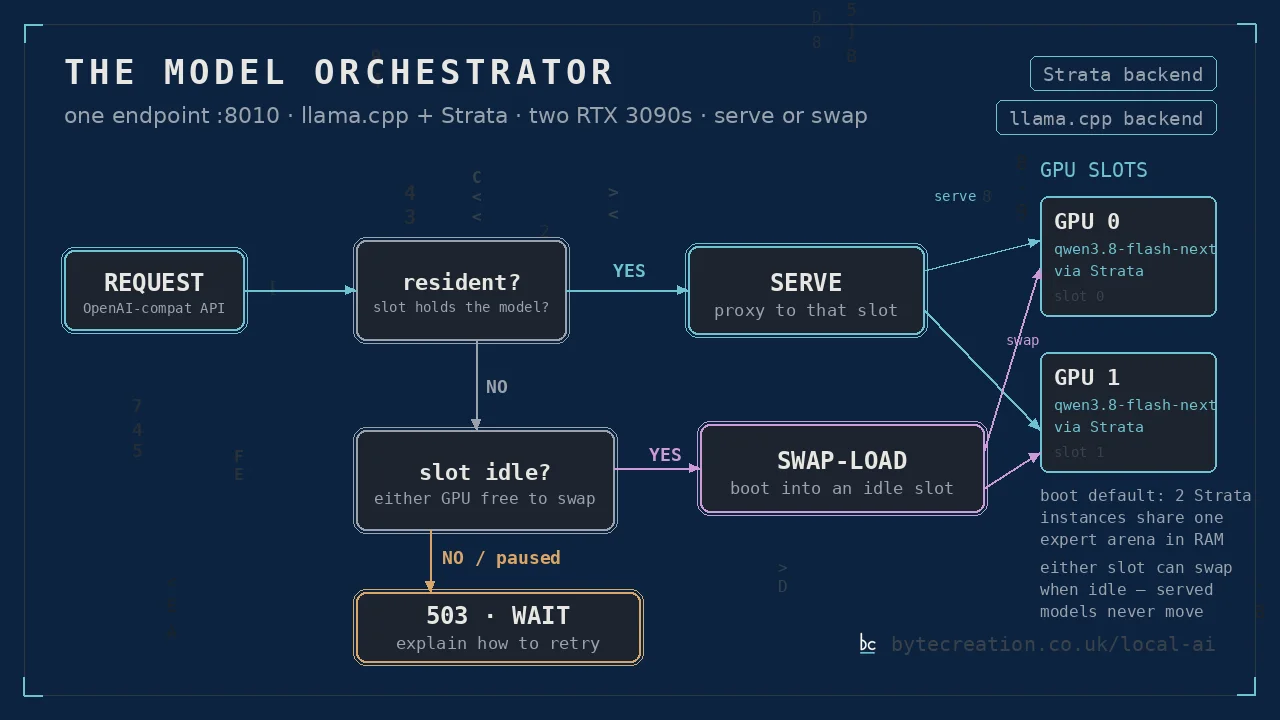
Eleven models, two GPUs, one OpenAI-compatible endpoint on port 8010, no cloud. This post describes the orchestrator that serves all of the installed models. The technology is unremarkable: a FastAPI proxy and a JSON registry. The code itself is published: ByteCreation/orchestrator (MIT).
The shape of it
A Python FastAPI service, running as a systemd unit, listens on :8010 and owns two child llama-server processes, one slot per GPU, on localhost ports 8011/8012. Clients only ever talk to 8010. Models live in registry.json: weights path, context size, KV-cache quantization, batching, sampling, reasoning flags, and which GPUs the model fits on. Serving a model means having it loaded in a slot. The orchestrator’s task is deciding which slot holds what, and when.
| Slot | GPU | Child port | Boot default |
|---|---|---|---|
| 0 | 0 | 127.0.0.1:8011 | qwen3.8-flash-next (Strata) |
| 1 | 1 | 127.0.0.1:8012 | qwen3.8-flash-next (Strata) |
Child servers are localhost-only. Only the proxy faces the network. One model per slot at a time. The runtime backend follows the registry entry, normally llama-server, but the flagship entry declares "backend": "strata" and the orchestrator starts Strata Terminal as the slot child instead, with the same swap lifecycle.
Routing and swap rules
- Requested model already loaded? Served from that slot. With several matching slots, the least-busy one wins, ties round-robin.
- A ready slot that is only momentarily busy (empty queue, <2 active requests) continues-batches the request.
- Congested (≥2 active or queue backlog) and another slot idles on a different model? That idle slot swaps to the requested model.
- No slot available? Queue, up to 300 s (
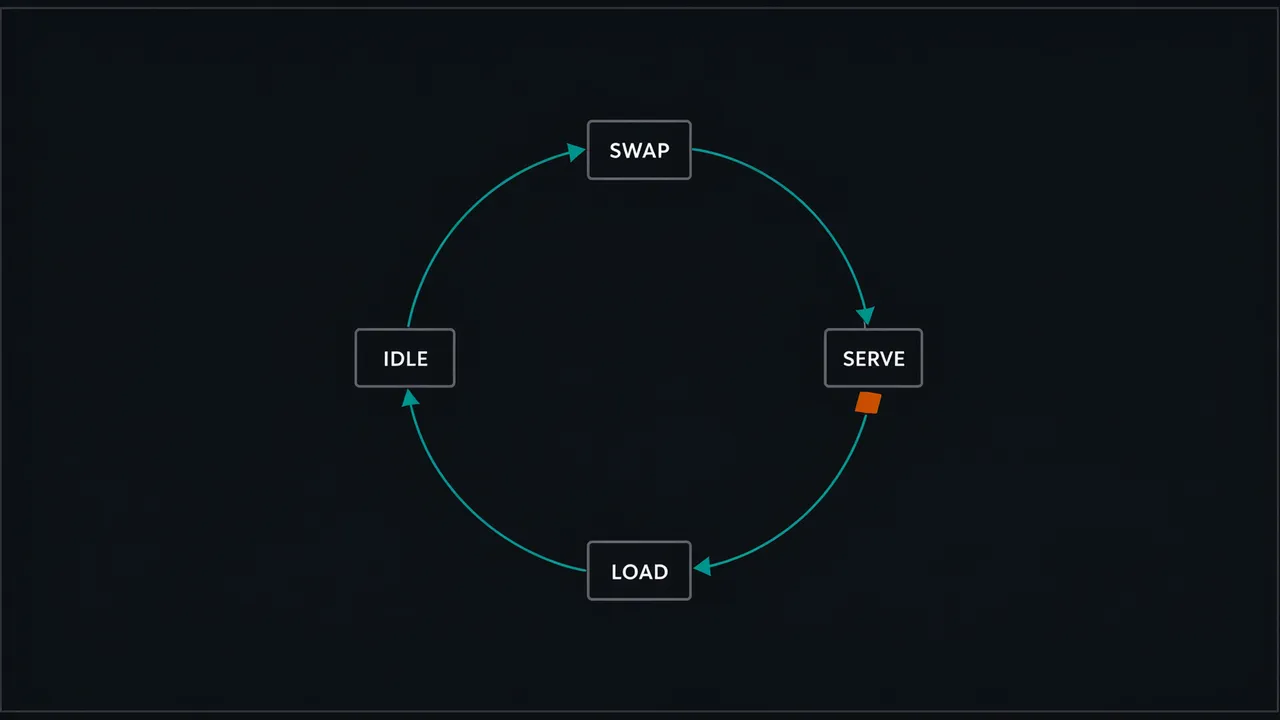
ORCHESTRATOR_QUEUE_TIMEOUT), then a clean HTTP 503. - Swap = kill the old child, wait for VRAM to drain below ~1 GiB, start the new model, wait for its
/health. A child that dies during boot fails the swap immediately instead of timing out. - Upstream errors (e.g. context exceeded) forward with their real HTTP status. Returning 200 for streaming errors had broken OpenAI-compatible clients.
The swap lifecycle
The registry
Every field the orchestrator understands:
| Field | Meaning |
|---|---|
gguf / mmproj | weights path; vision projector path (forced to CPU via --mmproj-device none) |
ctx_size | --ctx-size — everything here runs at 200,000 except the flagship at 262,144 |
gpu_layers | --n-gpu-layers; 99+ = full offload |
flash_attention | --flash-attn on |
cache_type_k/_v | KV quantization — the 200K-context enablers |
ubatch/batch | batching; big batches = fast prefill |
temperature/top_p/top_k | server-side sampling defaults |
reasoning/reasoning_format/reasoning_budget | thinking extraction (deepseek format = reasoning_content) + budget cap |
chat_template_kwargs | e.g. {“enable_thinking”:true} |
fit_gpu | which GPU slots the model fits on |
family | defaults like --n-cpu-moe 0 for MoE families |
use_mtp/mtp_n_max | MTP speculative decoding (--spec-type draft-mtp) |
wide_slot/split_mode/tensor_split | dual-GPU models |
backend | non-default engine — e.g. strata |
attachment/tool_call/output_limit | client-facing capability metadata |
A trimmed real entry, so you can pattern-match one for your own model:
{
  "gguf": "/mnt/data/llama-models/glm-4.7-flash/model.gguf",
  "ctx_size": 200000,
  "gpu_layers": 99,
  "flash_attention": true,
  "cache_type_k": "q4_0",
  "cache_type_v": "q4_0",
  "ubatch": 256,
  "batch": 2048,
  "temperature": 1.0,
  "top_p": 0.95,
  "reasoning": true,
  "reasoning_format": "deepseek",
  "chat_template_kwargs": "{"enable_thinking":true}",
  "fit_gpu": [
    0,
    1
  ],
  "family": "glm",
  "reasoning_budget": 4096
}Memory safety on a 128 GB host
The service cgroup carries a hard MemoryMax=110G and LimitMEMLOCK=infinity. The reason for the cap: two Strata instances once livelocked the host, cgroup max events 1,444×, oom_kill: 0, journald stopped writing, because the inference engine had allocated a private pinned huge-page arena (~47 GiB) per instance, leaving nothing reclaimable. No process was ever killed. The machine froze. The fix is a shared arena flag (--shared-expert-arena /dev/shm/…) so all instances map one tmpfs copy. Lesson for any RAM-heavy MoE setup: measure pinned/locked memory per process (smaps_rollup), not just totals.
Running it
curl -s http://127.0.0.1:8010/health            # slot state, active requests
curl -s http://127.0.0.1:8010/v1/models         # every installed model
curl -X POST http://127.0.0.1:8010/admin/slot/1/stop   # free GPU 1 (image-gen jobs, maintenance)
curl -X POST http://127.0.0.1:8010/admin/slot/1/start # bring it back with its boot modelThe admin endpoints make single-GPU image generation and LLM serving coexist: stop slot 1, run the diffusion job on GPU 1, restart the slot. Logs are per-slot (slot{0,1}-<model>.log) plus an orchestrator log, and a thermal watcher wraps every benchmark, both 3090s software-throttle around 72–76 °C, which is normal and affects all models equally.
Benchmarking discipline
All orchestrator numbers in this set come from the same like-for-like method unless noted: identical short prompt, max_tokens=512, temperature=0.7, two runs per model, median reported, models warmed first so load/swap time is excluded, and re-verified with server-reported timings, every model within a few percent, GPU-thermal variation accounted for). Direct runs use llama-cli at 8192 ctx, 256 generated tokens, q4_0 KV, flash-attn on. Both GPUs hit software-thermal/power-cap throttling at 72–76 °C under bench load. This affects all models similarly. Short-prompt prefill numbers are overhead-dominated and comparative only.
Upgrades move real numbers: the llama.cpp b11480→v0.7.0 jump alone changed generation throughput between −5% and +21% per model (six models improved 10–21%). Never quote a tok/s figure without its build, context length and method.
Limits
- One model per slot: swapping costs ~20–40 s for a llama.cpp model still warm in the 128 GB page cache (measured: gemma4 26 GB → 22 s, GLM-4.7 → 34 s), and ~75–80 s for the Strata flagship, which re-bakes its expert arena. The routing rules exist to make swaps rare, not free.
- Queue latency is real under contention, the 300 s ceiling turns overload into a clean 503, not a hang.
- Short-prompt prefill is overhead-dominated. Judge ingestion on long prompts.
- This is a LAN service: no auth, no multi-tenant isolation. Public exposure would need a completely different shape (proxy + caps), and that is a separate decision.
The engine underneath is llama.cpp (v0.7.0, CUDA, sm_86). The flagship slot uses Strata Terminal. The eleven models and their numbers: Local AI.
The code is open source: ByteCreation/orchestrator. The FastAPI service, a worked registry, systemd units and a recovery script. Every path is env-configurable. The prerequisites are two GPUs and a llama.cpp or Strata binary.