

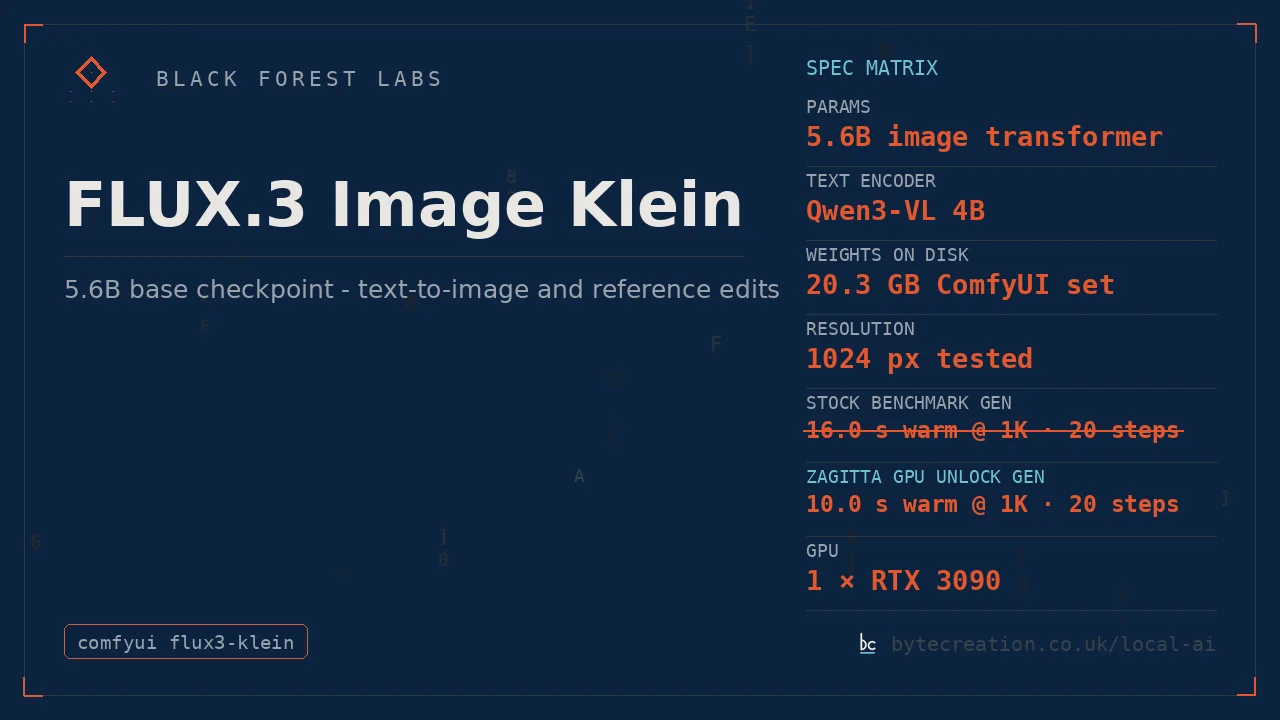
FLUX.3 Image Klein is a 5.6B model from Black Forest Labs. It runs on a headless ComfyUI stack. Lettering is routed to Qwen-Image-2.1, and every Klein prompt locally stays textless. The samples below are photographic scenes.
Black Forest Labs ships a standing instruction with the base model: do not use it without a prompt upsampler. Klein wants full scene captions. A short prompt typed as-is returns generic output. Their guidance is to use their upsampler or “any LLM you prefer” with a prompt that expands the request into one complete caption. Locally, the upsampler is the orchestrator’s chat model itself: the agent writes the caption sentence by sentence, the 5.6B draws it. The showcase below came out of that path.
Showcase



Specifications
| Field | Value |
|---|---|
| Architecture | 5,538,458,368-parameter image transformer (undistilled base, bf16) + Qwen3-VL-4B-Instruct text encoder + VAE |
| Engine | ComfyUI 0.41.0, headless, converted single-file weights |
| Served by | nothing on the network: driven by the orchestrator’s LLM like the other generator (orchestrator guide) |
| Weights | ComfyUI set: transformer 11.08 GB, text encoder 8.88 GB, VAE 0.34 GB (20.3 GB). The original split download tree is 44 GB |
| Resolutions | 1024×1024 tested; 1024×576 in the showcase below. Higher sizes untested here |
| Sampler | ours: 20 steps, cfg 3.5, Euler. Upstream base card: 50 steps, guidance 3.5; the distilled Klein variant (16 steps, no guidance) is not the installed checkpoint |
| Reference edits | the model takes up to 10 reference images for edits and compositions; the local workflow currently does text-to-image, the multi-reference graph is not built yet |
| Prompt upsampler | upstream insists on full scene captions and publishes flux-3-image-klein-pup (Qwen3.5-9B based); its own guidance is that any LLM can do the job. Here the orchestrator’s chat model writes the captions |
| GPU footprint | Single RTX 3090, running on the card the driver LLM is not on |
| VRAM observed | peak 19,228 MB on the job GPU while Klein jobs ran, sampled once per second (the 2048-class Qwen jobs on the same card read higher) |
| Licence | FLUX Kommunity License v.1.0 non-commercial use plus commercial Outputs for users under US$5M gross annualized revenue, with content-filter and AI-disclosure conditions. |
| Role here | Textless photographic imagery. Lettering stays on the other model: the lettering test garbled the last word of a prompted sign (record under Showcase): text stays off this model |
Generation times
| Run | Size | Steps | Stock | Zagitta GPU Unlock |
|---|---|---|---|---|
| 1024-class warm jobs, ComfyUI | 1024×576 | 20 | 16.0 s | 10.0 s |
| First Klein job in a session, stages its weights | 1024×576 | 20 | 22 s | 16.0 s |
Same single ComfyUI session as the Qwen-Image-2.1 batch in the other guide: mid-session the server staged Klein’s weights instead, and one eviction cycle served every image in the batch across the two models. The first job after the switch stages the weights and runs slower; every session since has repeated that pattern. Stock is the locked-card record: staging 22.0 s, warm 16.0 s. Zagitta GPU Unlock replays the same driver and settings on the unlocked card in one shared session (seeds 901–905): staging 16.0 s, four warm jobs 10.0 s. Times are wall-clock per image inside one open session.
GPU unlock: doubled tensor-core rate
The RTX 3090’s tensor-core rate is capped by its VBIOS well below what the silicon can do. gpu_unlock — an out-of-tree kernel module from the upstream Zagitta/gpu-unlock project — lifts that cap before the NVIDIA driver binds: one opt-in kernel argument and a reboot on this node, BF16 matrix throughput 70.7 → 112.0 TFLOPS (+58%), FP32 CUDA cores untouched. No VBIOS write: a boot without the argument is locked, and a power cycle re-locks the card.
Klein is the bigger gain of the two installed generators. The one controlled comparison on this node — identical seed, prompt and binaries, locked and unlocked boots on the same day, 1024×1024 at 20 steps, both runs:
| Run | Locked | Unlocked |
|---|---|---|
| 1024×1024, 20 steps, seed 42, both runs (same-day A/B) | 31.17 / 30.99 s | 22.92 / 21.76 s (−28% time) |
Execution time from the ComfyUI server log, model staging excluded. Showcase timings in this post predate the unlock.
The full same-day locked↔unlocked record — methodology, the 11-model LLM sweep, the synthetic GEMM check and the rollback kit — lives in the Zagitta GPU Unlock article.
How they run: the LLM is the control plane
The orchestrator never serves an image model. What it serves is the chat model that drives the whole job: An LLM running through the orchestrator receives a prompt to generate an image, picks an image generator, and writes the prompt for the image generator. The imagegen skill wraps the mechanics into one command:
/mnt/data/scripts/imggen-run /mnt/data/imggen/venv/bin/python
  /mnt/data/scripts/comfyui-gen.py --model flux3-klein
--prompt "..." --out /mnt/data/imggen/out/x.png --width 1024 --height 576imggen-run reads a GPU requirement per script from imggen-models.conf. For a single-GPU model it switches inference to imagegen-single mode: it stops the slot on the free GPU (here, slot 1), pins the job to that card with CUDA_VISIBLE_DEVICES=1, and leaves the slot the agent session itself is running on untouched. The generation job and the LLM that launched it share the hardware at the same time.
On exit the handler restores the stopped slot and its boot model, then verifies GET :8010/health before reporting success. The exit code tells the agent what happened:
| Exit code | Meaning | What the agent does |
|---|---|---|
| 0 | job done, orchestrator restored | read the image and check it |
| 1 | job error (OOM, crash) | lower steps/resolution, retry |
| 2 | orchestrator did not restore | run the recovery script before touching inference again |
| 124 / -15 / -9 | timeout / killed / crash | check logs, lower steps |
While a job holds the free GPU, requests that would need it get a clean HTTP 503 explaining the pause. Sessions on the resident slot continue normally. The evict/restore cycle costs roughly 60 s for the dual-GPU boot, so batches run all images in one session. Before any image reaches the site, the agent reads it with vision and checks it against the prompt (the QC gate in docs/IMAGE-STYLE.md): wrong lettering, extra people or garbled detail fails the read and the image is re-rolled, twice at most.
Memory & CPU
Klein’s own 1024-class jobs peaked at 19,228 MB on the job GPU (GPU-only sampling at one per second); the 2048-class Qwen job measured the same way reaches 23,728 MB, recorded in the other guide. The ComfyUI weight set is 20.3 GB on disk; the full downloaded tree (original split copies plus variants) is 44 GB. Host RAM and the resident LLM were untouched during generation.
Local config
The policy line, and the generation command:
# imggen-models.conf
comfyui-gen.py flux3-klein  1  1

# one image, GPU 1, LLM stays on GPU 0
IMGGEN_JOB_TIMEOUT=1800 /mnt/data/scripts/imggen-run
  /mnt/data/imggen/venv/bin/python /mnt/data/scripts/comfyui-gen.py
  --model flux3-klein --prompt "full scene caption..."
--out /mnt/data/imggen/out/x.png --width 1024 --height 576The workflow graph is the same shape as the other model’s, with clip_type: "flux3" and the three converted single files (flux3-klein.safetensors, flux3-klein-te.safetensors, flux3-klein-vae.safetensors), symlinked from the ComfyUI model dirs.
Build it yourself
Hardware. Model runs on one RTX 3090 (24 GB). The 20.3 GB set needs the whole card at generation time; 16 GB-class runs need offload experiments nobody has finished here.
- CPU: AMD Ryzen 9 5900X, 12 cores / 24 threads, Zen 3
- Motherboard: ASUS ROG STRIX X570-E GAMING WIFI II (AM4, ATX)
- GPU: 2× NVIDIA GeForce RTX 3090, 24 GB VRAM each (the model needs one card)
- Total VRAM: 48 GB (2 × 24 GB)
- System RAM: 128 GB DDR4 (~121.5 GiB usable)
- Storage: 2 TB KIOXIA EXCERIA NVMe SSD
- OS: Ubuntu 26.04.1 LTS, headless
- CUDA: toolkit at /usr/local/cuda-13.1
- PCIe topology: both GPUs on the CPU root complex. X8/x8 split when both slots populated (normal for this board); Gen1 at idle → PCIe 4.0 x8 under load. Nvidia-smi topo -m shows PHB between GPUs. No NVLink
- Cooling/chassis: open mining rig (GPU spacing + rig fans, no case). GPU 0 peaks ~73–74 °C under dual load. Routine sw_thermal/sw_power_cap throttle to ~76 °C is normal
- Kernel mitigations in place: pcie_aspm=off, LimitMEMLOCK=infinity, orchestrator MemoryMax=110G
Download. The base checkpoint’s HuggingFace repo is gated: accept the licence terms on the repo page, then fetch. The repo carries the bf16 transformer with fp8 and NVFP4 variants, the Qwen3-VL-4B-Instruct encoder and the autoencoder:
python - <<'PY'
from huggingface_hub import snapshot_download
snapshot_download('black-forest-labs/flux-3-image-klein-base',
                  local_dir='/mnt/data/imggen/flux3-klein')
PY

# repack into ComfyUI single-file format:
python /mnt/data/scripts/convert-flux3-klein-comfyui.pyThen apply the two ComfyUI patches (text-encoder detection in comfy/sd.py, Triton workaround in comfy/text_encoders/llama.py) or wait for upstream to absorb them, and symlink the three outputs into the model dirs. The conversion manifest is worth keeping: 357 tensors, source fp32, exported bf16, with the sha256 recorded.
Serve it. Identical to the other model: headless ComfyUI, one workflow JSON per image, one session per batch.
Gotchas
- Do not send it a bare phrase. The upstream card is blunt about the upsampler requirement. Every generation here goes through a full caption written by the driver LLM.
- diffusers compatibility is not there: the key naming mismatch is structural, the conversion is the supported route locally.
- ComfyUI will not load the converted files until both source patches are applied; the failure is a model-preparation error, not a missing file.
- The installed checkpoint is the undistilled base (upstream recommends 50 steps at guidance 3.5). Local generation runs at 20 steps by default; the distilled 16-step variant is a separate repo and is not installed.
- Lettering is not this model’s ground: the lettering test spelled “PINE HOLLOW TRAIL” as “PINE HOLLOW TRAV!” on a trail sign: keep text out of Klein prompts and route words to the other guide
- Multi-reference editing is a documented model capability (up to 10 references) but the local workflow graph for it does not exist yet; only text-to-image has run here.
Links. black-forest-labs/flux-3-image-klein-base (installed) · flux-3-image-klein (distilled) (distilled, not installed) · flux-3-image-klein-pup (the upsampler BFL publishes) · BFL inference code · ComfyUI