

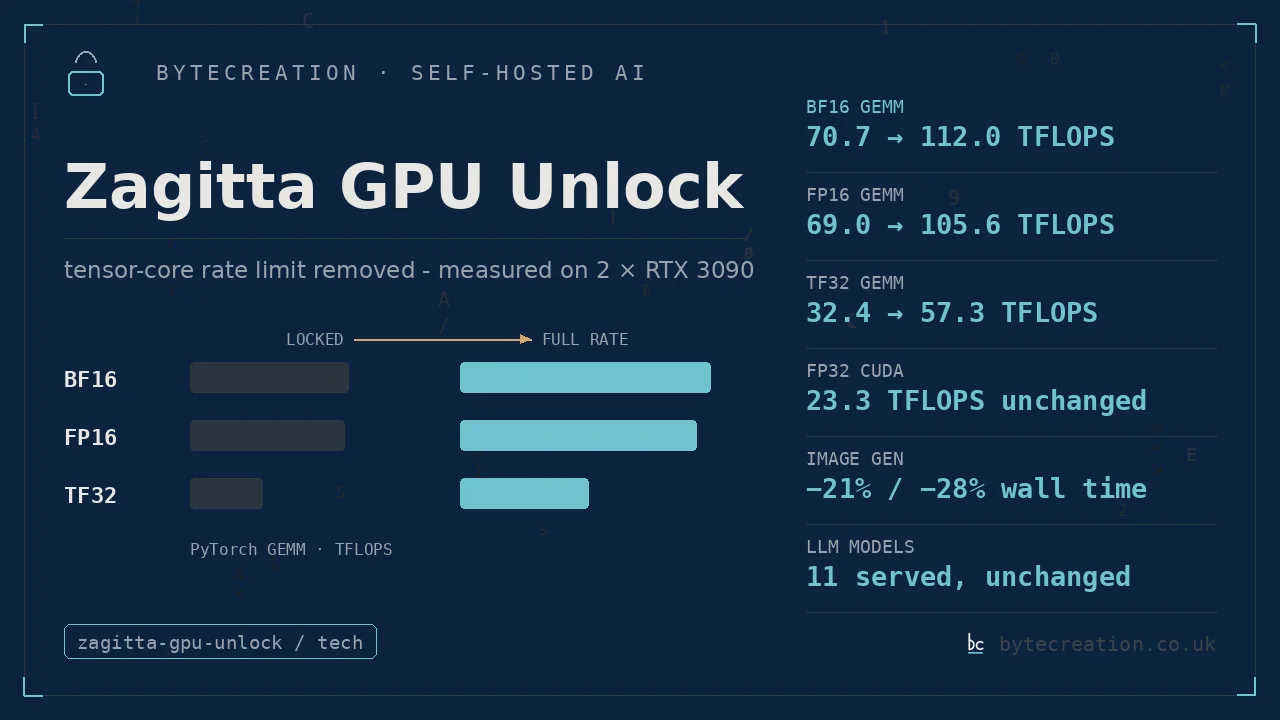
NVIDIA ships GeForce cards with their tensor cores capped to half speed for FP16, BF16 and TF32 math with FP32 accumulation, which is what nearly all AI training and unquantized inference uses. The same silicon sold as an RTX A-series or professional card runs at full rate. gpu_unlock removes that cap at boot, before the stock NVIDIA driver loads. No patched driver, no VBIOS flash, nothing to redo when NVIDIA releases a new driver. All measurements below were made on a 2 x RTX 3090 setup.
Orchestrator models — locked → unlocked
| Model | Prefill tok/s | Δ | Gen tok/s | Δ |
|---|---|---|---|---|
| qwen3-coder-30b-a3b | 13,448 → 12,046 | −10%* | 187.0 → 173.0 | −7%* |
| glm-4.7-flash | 9,704 → 9,398 | ≡ | 142.9 → 141.1 | ≡ |
| ornith-1.5-9b | 2,170 → 2,233 | ≡ | 118.6 → 118.4 | ≡ |
| qwen3.6-35b-a3b-mtp | 1,761 → 1,782 | ≡ | 186.4 → 186.8 | ≡ |
| qwen3.6-35b-a3b-mtp-vision | 1,807 → 1,771 | ≡ | 193.2 → 192.6 | ≡ |
| ornith-35b | 1,875 → 1,867 | ≡ | 165.7 → 164.5 | ≡ |
| gemma4-26b-a4b | 1,633 → 1,615 | ≡ | 141.8 → 142.2 | ≡ |
| qwen3.8-27b | 759 → 754 | ≡ | 64.7 → 66.5 | ≡ |
| ornith-1.5-35b-a3b | 1,882 → 1,917 | ≡ | 170.6 → 171.0 | ≡ |
| nemotron-3.5-bolt-74b-a9b-24gb | 877 → 886 | ≡ | 82.4 → 82.4 | ≡ |
| qwen3.8-flash-next (Strata) | 824 → 822 | ≡ | 123.3 → 124.2 | ≡ |
* coder’s outlier is run-to-run noise: the pre-unlock sweep measured 181.8 gen, and both new numbers bracket it. “≡” = within ±3% noise band.
Strata deep probes (flash-next)
| Probe | Locked | Unlocked | Δ |
|---|---|---|---|
| 7k-token prefill (seed-unique, median of 4) | 1,999 t/s | 2,048 t/s | +2.4% |
| Decode (512 tok, MTP) | 92.1 t/s | 88.9 t/s | ≡ (memory-bound) |
Real workloads — image generation
The ComfyUI rows below are real end-to-end model runs, the only workloads here that compute in native BF16 rather than quantized weights:
| Workload | Locked | Unlocked | Δ |
|---|---|---|---|
| ComfyUI Qwen-Image-2.1 1024²/20 steps | 49.4 / 45.1 s | 39.5 / 35.3 s | −21% time |
| ComfyUI FLUX.3 Klein 1024²/20 steps | 31.2 / 31.0 s | 22.9 / 21.8 s | −28% time |
Bottom line: the unlock is working, and all 11 GGUF-served LLMs (including Strata flash-next) are unchanged: quantized inference is bandwidth/dequant-bound, exactly as upstream predicts. Only the native-FP16/BF16 image generation improved, 21–28% in wall time.
Synthetic compute check (not a model run)
The table above is model results. This one is not: it is a synthetic microbenchmark, a timed dense matrix multiply (GEMM) on an otherwise empty GPU, no model and no weights. Its only job is to confirm the unlock did at the hardware level what upstream claims, and to show which units it touches. The FP32 row is the control: that math runs on the regular CUDA cores, which the unlock does not modify, so it is identical to the decimal.
| Workload | Locked | Unlocked | Δ |
|---|---|---|---|
| BF16 GEMM 8192³ | 70.7 TFLOPS | 112.0 | +58% |
| FP16 GEMM 8192³ | 69.0 | 105.6 | +53% |
| TF32 GEMM 4096³ | 32.4 | 57.3 | +77% |
| FP32 GEMM (CUDA cores) | 23.3 | 23.3 | 0% |
The tensor-core rate is doubled (+53–77%), CUDA-core FP32 is untouched, and the hardware is doing exactly what the patch says. What that does and does not buy at model level is what the first three tables measure.
The probe as run, identical in both states:
#!/usr/bin/env python3
"""gpu-unlock A/B hardware probe: tensor-core + FP32 GEMM rates.
Run standalone with the target GPU free (orchestrator stopped). Identical in both states."""
import torch, time
def bench(dtype, n, iters, tf32=False):
    torch.backends.cuda.matmul.allow_tf32 = tf32
    a = torch.randn(n, n, device="cuda", dtype=dtype)
    b = torch.randn(n, n, device="cuda", dtype=dtype)
    c = torch.empty_like(a)
    for _ in range(5): torch.matmul(a, b, out=c)
    torch.cuda.synchronize()
    t0 = time.perf_counter()
    for _ in range(iters): torch.matmul(a, b, out=c)
    torch.cuda.synchronize()
    dt = (time.perf_counter() - t0) / iters
    tf = 2 * n**3 / dt / 1e12
    print(f"{str(dtype):16s} tf32={int(tf32)} n={n} {tf:.1f} TFLOPS", flush=True)
    del a, b, c; torch.cuda.empty_cache()

print(torch.cuda.get_device_name(0))
bench(torch.bfloat16, 8192, 10)
bench(torch.float16, 8192, 10)
bench(torch.float32, 4096, 20, tf32=False)
bench(torch.float32, 4096, 20, tf32=True)How to do it
Build the DKMS module and firmware packages from the upstream source (make inputs, make deb), install the two .debs, add the opt-in kernel argument gpu_unlock.targets=0000:0a:00.0,0000:0b:00.0 to /etc/default/grub, run update-grub and reboot. The journal shows one unlocked line per card, and the unlock is volatile: remove the argument for a locked boot, and a power-off re-locks the card. Full instructions, supported device lists and the upstream rate tables live in the README.
Upstream: Zagitta/gpu-unlock (GPL-2.0).