

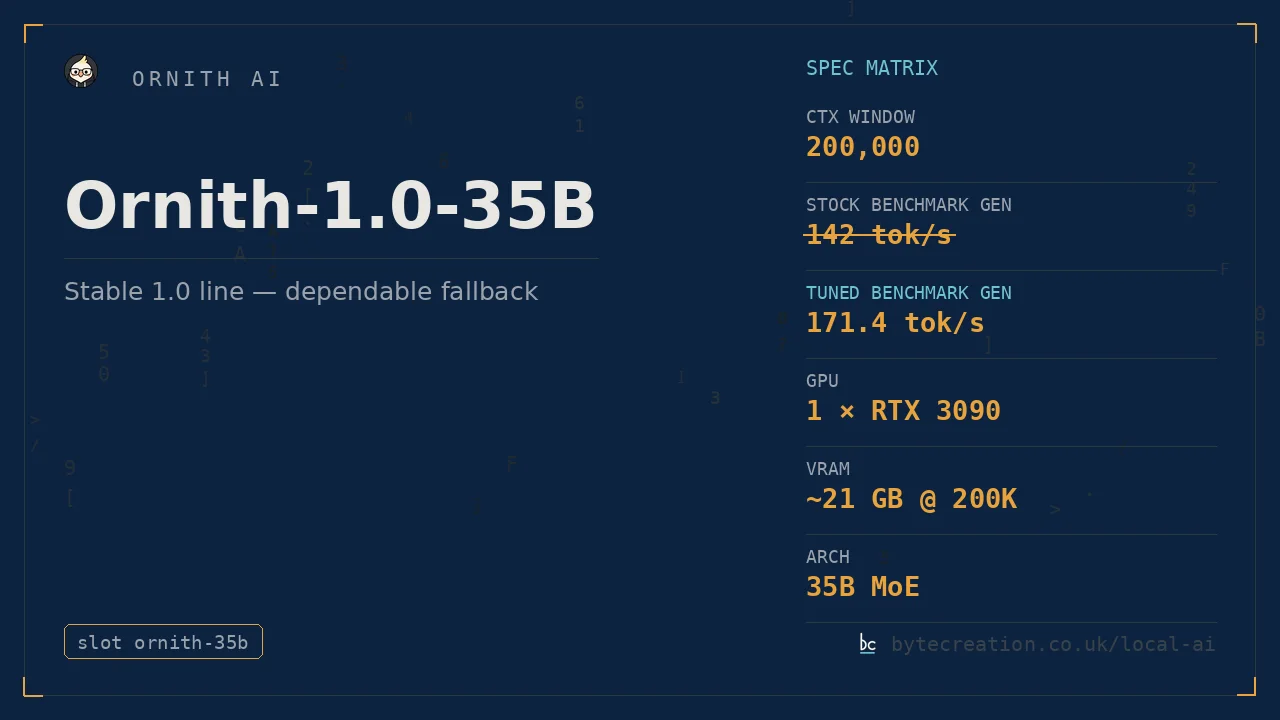
The 1.0-line fallback: Ornith 1.0’s 35B, an agentic-coding MoE with server-side thinking, 171.4 tok/s, 200K context, big batching (256/2048), no speculative decoding.
Why keep it next to the newer 1.5 (covered separately)? Same family (35B-A3B, 262K context, MIT licence), but 1.5 is a retrained model and it beats this one for agentic work. The 1.0 line has more mature, better-tested quants and a slightly lighter footprint, so it stays installed as the fast-loading fallback and the regression baseline. If the newer line regresses, one API call swaps this model back in.
It also runs through the llama.cpp v0.7.0 upgrade, which moved generation between −5% and +21% per model across six re-tested models. A tok/s figure without its build is not quotable.
Specifications
| Field | Value |
|---|---|
| Architecture | 35B total MoE |
| Served by | llama.cpp — the llama-server process behind the orchestrator |
| Weights | Q4_K_M, ~20 GB |
| Context | 200,000 |
| GPU footprint | Single RTX 3090 |
| VRAM on one RTX 3090 | ~21 GB @ 200K |
| Role here | Stable 1.0-line fallback (vs 1.5 quality) |
| Source | ornith-ai/Ornith-1.0-35B · GGUF: unsloth/Ornith-1.0-35B-GGUF (Q4_K_M) |
| KV cache | q4_0 (K and V) |
| Batching | ubatch 256 / batch 2048 |
| Reasoning | Server-side thinking (deepseek format, enable_thinking), budget 4,096 |
| Tools | Tool calling supported |
Benchmarks
| Run | Prompt tok/s | Gen tok/s |
|---|---|---|
| First run here (stock build, 8K ctx) | 287 | 141.7 |
| Orchestrator sweep | 1,874.7 tok/s | 171.4 tok/s |
| llama.cpp v0.7.0 upgrade check (@8K) | — | 172.7 tok/s (+21.4% vs b11480) |
Generation across the v0.7.0 sweep moved −5% to +21% per model; quote the build.
Stock vs tuned. No trustworthy published 3090 figure exists for the 1.0 line, so the stock number is our own first-run measurement locally: 141.7 tok/s.
Memory & CPU
~21 GB VRAM at 200K on one card. Per-slot RSS ~1–2 GiB; CPU negligible.
Local config
Verbatim entry from /mnt/data/llama-models/registry.json:
{
  "gguf": "/mnt/data/llama-models/ornith-35b/model.gguf",
  "ctx_size": 200000,
  "gpu_layers": 99,
  "flash_attention": true,
  "cache_type_k": "q4_0",
  "cache_type_v": "q4_0",
  "ubatch": 256,
  "batch": 2048,
  "temperature": 0.7,
  "top_p": 0.8,
  "top_k": 20,
  "reasoning": true,
  "reasoning_format": "deepseek",
  "chat_template_kwargs": "{"enable_thinking":true}",
  "fit_gpu": [
    0,
    1
  ],
  "family": "ornith",
  "wide_slot": false,
  "n_cpu_moe": 0,
  "attachment": false,
  "tool_call": true,
  "output_limit": 32768,
  "reasoning_budget": 4096
}Build it yourself
Hardware. Model runs on 1 x RTX 3090 24G.
- CPU: AMD Ryzen 9 5900X, 12 cores / 24 threads, Zen 3
- Motherboard: ASUS ROG STRIX X570-E GAMING WIFI II (AM4, ATX)
- GPU: 2× NVIDIA GeForce RTX 3090, 24 GB VRAM each (the model needs one card)
- Total VRAM: 48 GB (2 × 24 GB)
- System RAM: 128 GB DDR4 (~121.5 GiB usable)
- Storage: 2 TB KIOXIA EXCERIA NVMe SSD
- OS: Ubuntu 26.04.1 LTS, headless
- CUDA: toolkit at /usr/local/cuda-13.1
- PCIe topology: both GPUs on the CPU root complex. X8/x8 split when both slots populated (normal for this board); Gen1 at idle → PCIe 4.0 x8 under load. Nvidia-smi topo -m shows PHB between GPUs. No NVLink
- Cooling/chassis: open mining rig (GPU spacing + rig fans, no case). GPU 0 peaks ~73–74 °C under dual load. Routine sw_thermal/sw_power_cap throttle to ~76 °C is normal
- Kernel mitigations in place: pcie_aspm=off, LimitMEMLOCK=infinity, orchestrator MemoryMax=110G
Download.
hf download unsloth/Ornith-1.0-35B-GGUF
Ornith-1.0-35B-Q4_K_M.gguf --local-dir /mnt/data/llama-models/ornith-35bSet family: "ornith" in the registry entry, MoE experts then stay on GPU (--n-cpu-moe 0).
Register & serve. Add an entry to your registry.json (schema in the orchestrator post), restart the service, then smoke-test:
curl -s http://127.0.0.1:8010/v1/chat/completions
  -H "Content-Type: application/json"
-d '{"model":"ornith-35b","messages":[{"role":"user","content":"What is 2+2? Answer with just the number."}],"max_tokens":64}'A correct short answer with no errors means the model is live on the endpoint. Watch GET /health while a slot loads (~20–40 s warm for this size).
Gotchas
- The org’s 1.5 line supersedes this for agentic work, try both, the speed delta is real (see the 1.5 post).
- Thinking is server-side: clients that also request thinking will double-count tokens.
Links. Model card · Unsloth GGUF · Ornith on HuggingFace