

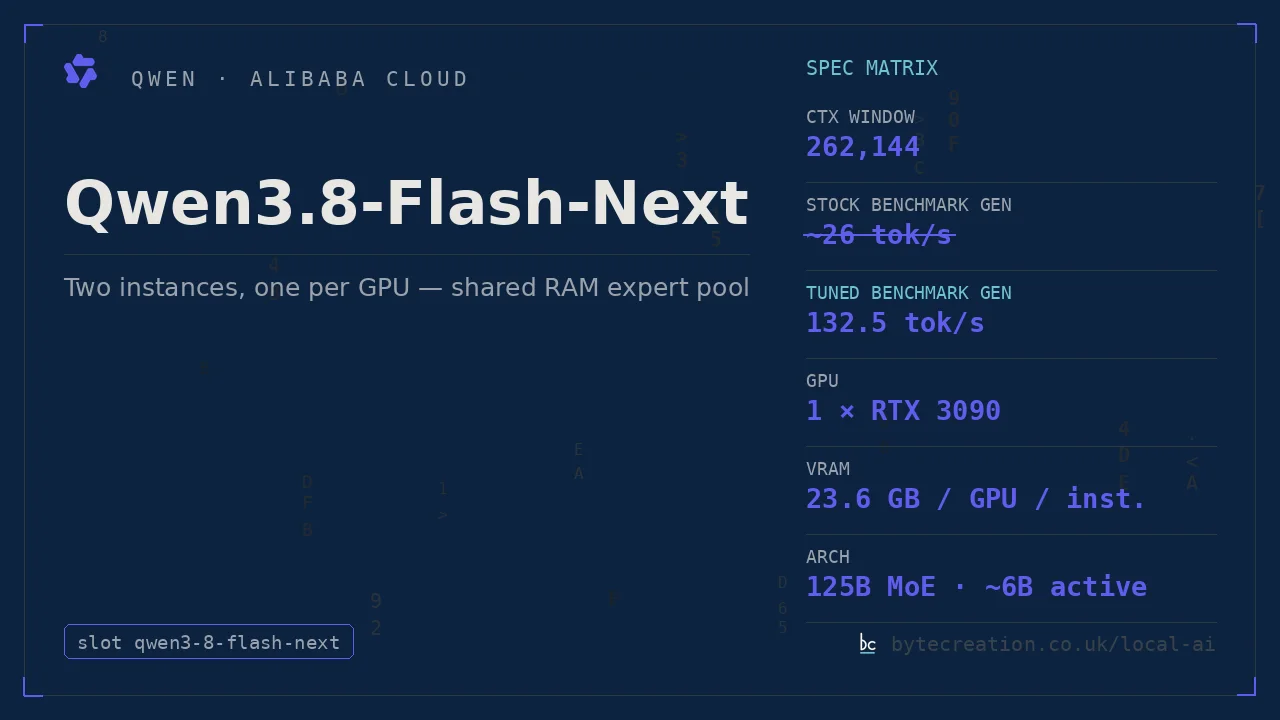
When Qwen3.8-Flash-Next was first installed, it managed ~25 gen tok/s on a single RTX 3090 with 64k context. By comparison, the first run of Qwen3.6 here was ~125 gen tok/s (it has since improved to 192.9 tok/s, see Qwen3.6-35B-A3B with MTP). Both are mixture-of-experts models and Qwen3.6 has 35 billion parameters with 3 billion active, while Qwen3.8-Flash-Next has 125 billion parameters with 6 billion active. Using the updated and larger model was preferred as it’s more capable, but not at such a reduced speed. There is another Qwen3.8 model available at 27b, but that’s a dense model, not MoE, so the performance isn’t expected to match the speed of Qwen 3.6. No Qwen 3.8 MoE 27b or 32b seems to be planned as Alibaba Cloud focuses on the Qwen 4 architecture.
It was a shame not to be able to use Qwen 3.8 27b or Qwen3.8-Flash-Next 125b as they were both too slow for real use, and Qwen3.6 27b MoE continued to be the daily driver. Then enter Strata, an open-source project designed to run large target models on local hardware. It moves much of the 125b weight into RAM, offloads some compute to the CPU, and keeps the MoE layers in VRAM for fast responses. After installing Strata, the performance increase was immediate, and after a day of configuration tweaks the node now runs 2 x Qwen3.8-Flash-Next simultaneously at 262k context, one instance on each of the RTX 3090 cards, at ~133 tok/s each at the default thinking level. This is the new daily driver.
Any agent API request first reaches the orchestrator, which routes Qwen3.8-Flash-Next requests to Strata instead of llama.cpp. Other requests that use llama.cpp run as normal, and model switching is again handled by the orchestrator.
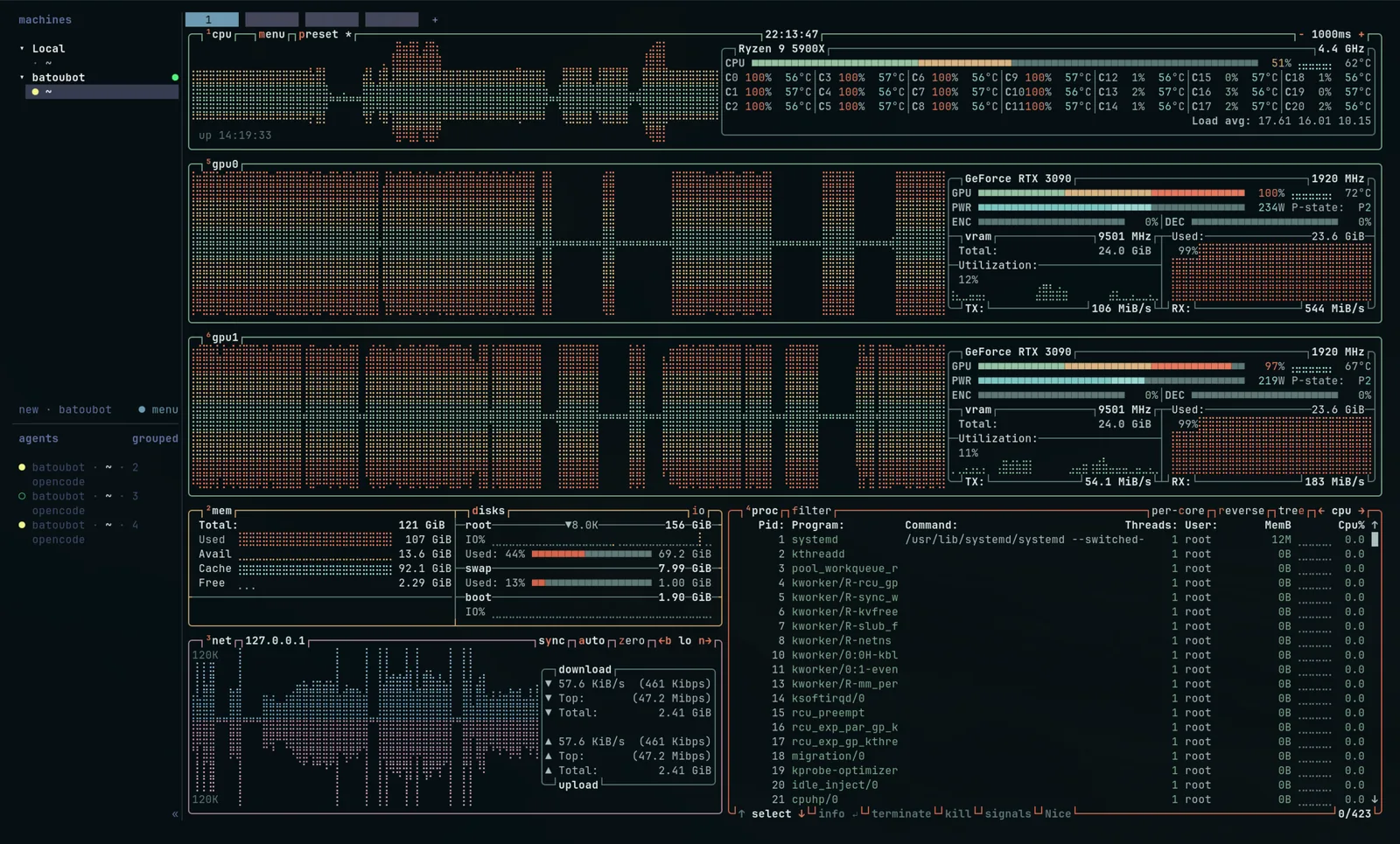
The hardware is being pushed, but it’s responsive. At over 130 tok/s, Qwen3.8-Flash-Next is generating text at a useful speed and work gets done without waiting around for the LLM to catch up.
The key setting to get two Qwen3.8-Flash-Next running simultaneously was --shared-expert-arena. Without it, every instance pins its own ~47 GiB copy of the expert weights in RAM, and starting a second instance on the second GPU crashed the system (the memory outage issues reported below). With it, both instances map the same tmpfs arena, so a second live conversation costs only ~8–10 GiB of extra RAM and a few CPU cores, each decoding at ~132.5 tok/s at the default thinking level.
Specifications
| Field | Value |
|---|---|
| Architecture | 125B total / ~6B active MoE (Strata backend) |
| Weights | IQ3_S model set, ~84.5 GB on disk |
| Context | 262,144 |
| GPU footprint | One RTX 3090 per instance; the boot default runs two instances side by side |
| VRAM on one RTX 3090 | ~23.6 GB / GPU (×2) |
| Role here | Daily driver; two instances, one per GPU |
| Source | Base model: Qwen/Qwen3.8-Flash-Next IQ3_S quant family in use: ISTA-DASLab/Qwen3.8-Flash-Next-GSQ-RCO-GGUF Engine: Strata |
| Files on disk | (~84.5 GB) + packs + MTP drafts |
| KV cache | k8v4 (8-bit K / 4-bit V), resident 32,768 cells, no conversation-cache cap (auto 8 GiB) |
| Vision | Yes — strata-vision process, mmproj BF16 on CPU, 12 threads |
| Reasoning | Server-side thinking, returned as reasoning_content (deepseek format); three levels: low (default, budget 4,096), medium (8,192), xhigh (16,384) |
| Tools | Tool calling supported |
Benchmarks
| Run | Prompt tok/s | Gen tok/s |
|---|---|---|
| First runs here (llama.cpp, 44/56 CPU/GPU split) | ~75–227 | ~26 |
| Strata, warm, via orchestrator (default thinking) | 728.1 | 132.5 |
| Strata, warm, direct to slot | — | 122.6 |
| 7,402-token prefill spot-check | ~1,990 tok/s | — |
| 100,349-token prefill | 2,414 tok/s | — |
| Strata, one instance loaded across both GPUs (2 x RTX 3090) | 177.6 | 141.2 |
Warm-latency when resident: ~0.3–0.9 s to first token; first load ~40–55 s.
An earlier “~117 tok/s at 4K prefill” figure was short-prompt overhead; large prefills are far faster (see the 100K prefill row).
Stock vs tuned. First time this model ran here: a llama.cpp CPU/GPU split at ~26 tok/s. The published community single-3090 figure (Q4 + heavy CPU offload) is ~15–19. Big difference with Strata.
Thinking levels
Thinking is server-side and bounded by a token budget as well as by prompt style. Three levels are defined, and each sets two things at once: the reasoning instruction injected through the chat template, and a hard cap on thinking tokens.
| Thinking level | Budget | Use | Prompt tok/s | Gen tok/s |
|---|---|---|---|---|
low (default) | 4,096 tokens | daily driving, brief thinking, answers arrive inline | 728.1 | 132.5 |
medium | 8,192 tokens | coding and agent loops, multi-step tool use | 553.8 | 119.3 |
xhigh | 16,384 tokens | the hardest reasoning problems | 834.3 | 116.0 |
Measured locally through the orchestrator with both instances resident: a 512-token run per level, two runs each, median, idle node. The prompt figures are overhead-dominated at this prompt size and comparative only.
Through the API the level is the OpenAI-compatible reasoning_effort field, low / medium / xhigh, sent at the top level of the request body. The orchestrator pairs each level with its budget for Strata-backed models: low with 4,096 tokens, medium with 8,192, xhigh and high with 16,384. A request naming no level gets the serve-profile default: low with a 4,096-token budget. A request that carries its own reasoning_budget_tokens keeps that number instead. Changing levels costs nothing: no model reload, no re-prefill, the level is a per-request parameter.
In OpenCode the levels attach to the model entry as variants: ctrl+t cycles low → medium → xhigh within a session, variant.list picks one directly. One model entry, one pair of GPU slots, and each session runs at its own level.
Memory & CPU
Per instance the process shows ~82–84 GiB RSS — but the 46.9 GiB expert arena in /dev/shm is shared (MAP_SHARED) between instances, so a second running copy costs only ~8–10 GiB extra. Add the ~26.8 GiB mlocked PLE (n-gram) table (--ple-io ram, needs LimitMEMLOCK=infinity), ~2.4 GiB pinned KV at 262K context, and ~1.1 GiB for the vision process. Steady state with two instances on a 128 GB host: ~93 GiB used, ~27 GiB free.
CPU is busy on this model as expert streaming and the PLE lookup are memory-bandwidth work. The other models here are GPU-resident and barely touch the CPU; this one is a constant load of several cores. It is fast though, feels responsive.
Local config
Verbatim entry from /mnt/data/llama-models/registry.json:
{
  "backend": "strata",
  "strata_profile": "/home/adam/.local/share/strata/profiles/strata-single.json",
  "family": "qwen",
  "wide_slot": false,
  "fit_gpu": [
    0,
    1
  ],
  "attachment": true,
  "tool_call": true,
  "output_limit": 32768,
  "ctx_size": 262144,
  "reasoning": true,
  "reasoning_format": "deepseek",
  "reasoning_budget": 4096,
  "description": "Qwen3.8-Flash-Next via Strata. Single-GPU, dynamically loaded onto whichever GPU the orchestrator frees."
}Build it yourself
Hardware. Model runs across 2 x RTX 3090 24G.
- CPU: AMD Ryzen 9 5900X — 12 cores / 24 threads, Zen 3
- Motherboard: ASUS ROG STRIX X570-E GAMING WIFI II (AM4, ATX)
- GPU: 2× NVIDIA GeForce RTX 3090, 24 GB VRAM each (single card needed per instance, can run on 1 card)
- Total VRAM: 48 GB (2 × 24 GB)
- System RAM: 128 GB DDR4 (~121.5 GiB usable)
- Storage: 2 TB KIOXIA EXCERIA NVMe SSD
- OS: Ubuntu 26.04.1 LTS, headless
- CUDA: toolkit at /usr/local/cuda-13.1
- PCIe topology: both GPUs on the CPU root complex; x8/x8 split when both slots populated (normal for this board); Gen1 at idle → PCIe 4.0 x8 under load; nvidia-smi topo -m shows PHB between GPUs; no NVLink
- Cooling/chassis: open mining rig (GPU spacing + rig fans, no case). GPU 0 peaks ~73–74 °C under dual load; routine sw_thermal/sw_power_cap throttle to ~76 °C is normal
- Memory ceiling rule: ~176 GB combined (48 VRAM + 128 RAM); Flash-Next dual fits at ~91–94 GiB host RAM via the shared /dev/shm arena (/dev/shm is 61 GiB)
- Kernel mitigations in place: pcie_aspm=off, LimitMEMLOCK=infinity, orchestrator MemoryMax=110G
Download.
“`bash # install Strata Terminal curl -fsSL https://github.com/Niko1221/Strata/releases/latest/download/install.sh | sh # set data dir (systemd drop-in: STRATA_DATA_DIR=/mnt/data/strata), then # fetch the iq3_s model set for Qwen3.8-Flash-Next per Strata’s model docs “`The orchestrator entry is the only one with "backend": "strata"; it starts Strata as a slot child exactly like a llama-server model, so swaps work the same way. The run profile (see config below) is the real config: --max-context 262144 --kv k8v4 --ple-io ram --kv-resident 32768 --vision --shared-expert-arena /dev/shm/qwen38-fn.arena.
Gotchas
--shared-expert-arenais not optional for dual boot. Without it the engine may materialise a private pinned THP arena (~47 GiB) per instance; two of those livelocked this host (cgroupmaxevents 1,444×,oom_kill: 0— a reclaim storm, not a crash). With the flag, one shared copy serves both.- Pin
reasoning_effort; do not ride the template default. The Flash-Next chat template falls back toxhighwhen a request carries no effort.xhighplus a self-referential prompt (the model asked about its own reasoning) produces reasoning-only replies with no visible answer. The serve profile pinslow, and the orchestrator’s effort-to-budget pairing keeps the cap real. Keepxhighopt-in. - Keep
MemoryMax=110Gon the service cgroup andLimitMEMLOCK=infinity. - After a service restart, the cgroup charge under-reads reality (tmpfs + page-cache pages stay charged to the dying generation) — watch host
MemAvailable, not the cgroup number. --max-contextbarely moves the RSS floor (200K vs 262K both ~82 GiB);Cachedinfreeoverstates available memory because mlocked/pinned pages are not reclaimable.
Links. Base model card · IQ3_S quant family · Strata Terminal · Strata model docs