

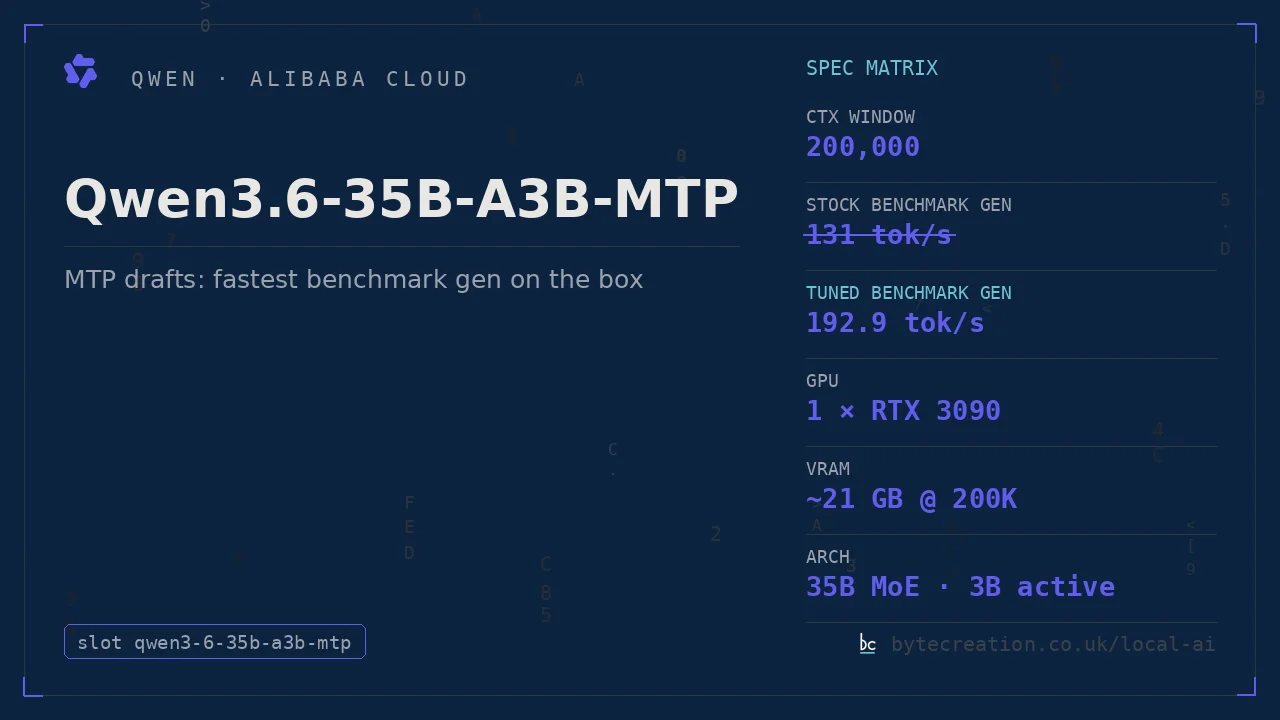
Qwen3.6 is what this setup ran every day before the flagship arrived, and it is still the fastest generator locally. The recipe: the 35B MoE (3 billion active parameters) with MTP (multi-token prediction) switched on. It measures 192.9 tok/s at 200K context.
First run here was a stock llama.cpp build: ~131 tok/s, matching the published community baseline for a 3090 (~120–136 tok/s). This GGUF ships an embedded draft head, so MTP is two registry lines (use_mtp: true, mtp_n_max: 1), no sidecar model, and with q4_0 KV and small batches decode lands at 192.9, about 50% faster than the same model with speculation off at 8K.
Specifications
| Field | Value |
|---|---|
| Architecture | 35B total / ~3B active MoE |
| Served by | llama.cpp — the llama-server process behind the orchestrator |
| Weights | Unsloth UD-Q4_K_XL, ~22 GB |
| Context | 200,000 |
| GPU footprint | Single RTX 3090 |
| VRAM on one RTX 3090 | ~21 GB @ 200K |
| Role here | Fastest generation; chat-heavy work |
| Source | Base: Qwen/Qwen3.6-35B-A3B · GGUF: unsloth/Qwen3.6-35B-A3B-MTP-GGUF |
| KV cache | q4_0 (K and V) |
| MTP | use_mtp: true, mtp_n_max: 1 (--spec-type draft-mtp) |
| Batching | ubatch 32 / batch 256 |
| Reasoning | Server-side thinking (deepseek format), budget 4,096 |
| Tools | Tool calling supported |
Benchmarks
| Run | Prompt tok/s | Gen tok/s |
|---|---|---|
| First run here (stock llama.cpp build, 8K ctx) | 314 | 131.2 |
| Orchestrator sweep | 1,793.5 tok/s | 192.9 tok/s |
| Direct llama-cli @ 8K | 268.4 tok/s | 194.1 tok/s |
| Story task: 5,000-word request | 7.5 s to first token | 141.9 tok/s wall; 18% faster end-to-end than non-MTP |
Method: identical short prompt, 512 generated tokens, median of 2 warm runs. Direct runs at 8192 ctx, 256 tokens, q4_0 KV, flash-attn on.
Stock vs tuned. First run here with a stock build: 131.2 tok/s (published community baselines cluster ~120–136). The delta: MTP speculative decoding (--spec-type draft-mtp) plus KV/batch tuning at 200K context.
Memory & CPU
~21 GB VRAM at 200K context on one 3090. Per-slot host RSS ~1–2 GiB. Fully GPU-resident: CPU usage is negligible.
VRAM ceiling note: mtp_n_max: 1 is the highest draft depth that fits at 200K on a single 3090, n=2 and n=3 OOM.
Local config
Verbatim entry from /mnt/data/llama-models/registry.json:
{
  "gguf": "/mnt/data/llama-models/qwen3.6-35b-a3b-mtp-vision/Qwen3.6-35B-A3B-UD-Q4_K_XL.gguf",
  "ctx_size": 200000,
  "gpu_layers": 99,
  "flash_attention": true,
  "cache_type_k": "q4_0",
  "cache_type_v": "q4_0",
  "ubatch": 32,
  "batch": 256,
  "temperature": 0.7,
  "top_p": 0.8,
  "top_k": 20,
  "reasoning": true,
  "reasoning_format": "deepseek",
  "chat_template_kwargs": "{"enable_thinking":true}",
  "fit_gpu": [
    0,
    1
  ],
  "family": "qwen",
  "wide_slot": false,
  "attachment": false,
  "tool_call": true,
  "output_limit": 32768,
  "use_mtp": true,
  "mtp_n_max": 1,
  "reasoning_budget": 4096
}Build it yourself
Hardware. Model runs on 1 x RTX 3090 24G. 32 GB of system RAM is plenty, the model is fully GPU-resident.
- CPU: AMD Ryzen 9 5900X, 12 cores / 24 threads, Zen 3
- Motherboard: ASUS ROG STRIX X570-E GAMING WIFI II (AM4, ATX)
- GPU: 2× NVIDIA GeForce RTX 3090, 24 GB VRAM each (the model needs one card)
- Total VRAM: 48 GB (2 × 24 GB)
- System RAM: 128 GB DDR4 (~121.5 GiB usable)
- Storage: 2 TB KIOXIA EXCERIA NVMe SSD
- OS: Ubuntu 26.04.1 LTS, headless
- CUDA: toolkit at /usr/local/cuda-13.1
- PCIe topology: both GPUs on the CPU root complex. X8/x8 split when both slots populated (normal for this board); Gen1 at idle → PCIe 4.0 x8 under load. Nvidia-smi topo -m shows PHB between GPUs. No NVLink
- Cooling/chassis: open mining rig (GPU spacing + rig fans, no case). GPU 0 peaks ~73–74 °C under dual load. Routine sw_thermal/sw_power_cap throttle to ~76 °C is normal
- Kernel mitigations in place: pcie_aspm=off, LimitMEMLOCK=infinity, orchestrator MemoryMax=110G
Download.
hf download unsloth/Qwen3.6-35B-A3B-MTP-GGUF
Qwen3.6-35B-A3B-UD-Q4_K_XL.gguf --local-dir /mnt/data/llama-models/qwen3.6-35b-a3bThe GGUF ships an embedded MTP head, no sidecar draft model needed. Set use_mtp: true, mtp_n_max: 1, and keep batches small (32/256) the way the tuned entry does.
Register & serve. Add an entry to your registry.json (schema in the orchestrator post), restart the service, then smoke-test:
curl -s http://127.0.0.1:8010/v1/chat/completions
  -H "Content-Type: application/json"
-d '{"model":"qwen3.6-35b-a3b-mtp","messages":[{"role":"user","content":"What is 2+2? Answer with just the number."}],"max_tokens":64}'A correct short answer with no errors means the model is live on the endpoint. Watch GET /health while a slot loads (~20–40 s warm for this size).
Gotchas
mtp_n_max: 2/3loads fine at short contexts but OOMs at 200K, cap at 1 if you run long contexts.- Prompt processing runs slower with MTP than the same model without speculation. The 5,000-word story task still finished 18% faster end-to-end, so the trade is worth taking for chat and agent work.
- Community reports and our own observation of agent-loop churn both suggest MTP gains shrink under sustained tool-call churn. The +53% was measured at 8K context on chat-style workloads.
Links. Base model card · GGUF repo · Apache-2.0 licence