

To my eye there are currently two public narratives regarding web security in October and November of 2026.
The more prevalent narrative is:
The invention of LLMs has accelerated the discovery of bugs and security fixes. The recent increase in CVEs and mention of online security issues in the press is down to this new technology.
And the counter narrative is:
While LLMs are becoming more useful over time when it comes to software development, they are not having the impact being reported. The main driver behind the increased mention of online security issues in the press is down to AI companies marketing how amazing their products are to sell more tokens. It’s not as bad as being reported.
This looks somewhat testable to me. We can look at what’s happening now and test the narratives above — do they describe a phenomenon that exists in reality? Is the explanation compelling? And will this hold in the last couple of months of 2026?
Value Free Narrative
Based on the evidence presented in this article, the following narrative can be supported:
What follows is a collection of data that was used to test existing narratives and form the value free one. This will be updated at the end of 2026 to see if the value free narrative holds.
The sibling articles AI Bug Hunting and the 2026 Kernel CVE Spike and Frontier LLM use in security fixes measure the same wave from the kernel’s own records and through the discovery-to-fix pipeline; this one measures CVEs for selected web services.
PHP
Peak 53 CVEs · mean 2.1 per month · hover, tap, or use the arrow keys
Peak 120 CVEs · mean 25.3 per year · hover, tap, or use the arrow keys
Show all 30 rows
| Year | CVEs | Cumulative |
|---|---|---|
| 1997 | 3 | 3 |
| 1998 | 0 | 3 |
| 1999 | 0 | 3 |
| 2000 | 3 | 6 |
| 2001 | 4 | 10 |
| 2002 | 13 | 23 |
| 2003 | 11 | 34 |
| 2004 | 6 | 40 |
| 2005 | 20 | 60 |
| 2006 | 33 | 93 |
| 2007 | 114 | 207 |
| 2008 | 21 | 228 |
| 2009 | 22 | 250 |
| 2010 | 36 | 286 |
| 2011 | 36 | 322 |
| 2012 | 22 | 344 |
| 2013 | 14 | 358 |
| 2014 | 36 | 394 |
| 2015 | 42 | 436 |
| 2016 | 120 | 556 |
| 2017 | 46 | 602 |
| 2018 | 24 | 626 |
| 2019 | 34 | 660 |
| 2020 | 19 | 679 |
| 2021 | 8 | 687 |
| 2022 | 8 | 695 |
| 2023 | 7 | 702 |
| 2024 | 18 | 720 |
| 2025 | 13 | 733 |
| 2026 | 27 | 760 |
The two spikes are artefacts of how records land. The 2007 wave clusters around the 5.2.1 and 5.2.2 releases — the safe_mode-bypass disclosures of the Hardened-PHP era, assigned as fast as full-disclosure mail traffic landed — and the 2016 peak is a publication batch, not a disclosure wave: 32 of the 53 records in its tallest month carry pre-2016 identifiers, published in three dated batches.
nginx
Peak 7 CVEs · mean 0.3 per month · hover, tap, or use the arrow keys
Peak 18 CVEs · mean 3.3 per year · hover, tap, or use the arrow keys
The shape tracks F5’s advisory cadence rather than organic traffic: all 2026 records are assigned by F5’s own CNA, arriving as a six-record out-of-band notification and a six-record quarterly notification, each covering one release of fixes.
MySQL Server
Peak 73 CVEs · mean 4.9 per month · hover, tap, or use the arrow keys
Peak 154 CVEs · mean 56.4 per year · hover, tap, or use the arrow keys
The shape is Oracle’s Critical Patch Update calendar rather than organic disclosure: 88% of the records arrive on dates that each carry at least ten, and three quarters fall in the four CPU quarters. The tallest month sits in 2022 and the busiest year is 2021.
MariaDB Server
Peak 25 CVEs · mean 1.6 per month · hover, tap, or use the arrow keys
Peak 57 CVEs · mean 18.9 per year · hover, tap, or use the arrow keys
No audit or disclosure wave is publicly documented behind the 2022 peak. What the record shows: the 2026 entries arrive as coordinated GitHub-advisory batches patched across four maintenance branches at once, and much of the 2010s volume rides MySQL-era assignments inherited by the fork.
Valkey
Peak 3 CVEs · mean 0.2 per month · hover, tap, or use the arrow keys
Peak 3 CVEs · mean 1.7 per year · hover, tap, or use the arrow keys
The fork’s own CVE record is only three years old and tiny; two of the five records are Redis-lineage bugs to which NVD also attached Valkey version criteria.
Redis
Peak 8 CVEs · mean 0.5 per month · hover, tap, or use the arrow keys
Peak 15 CVEs · mean 5.7 per year · hover, tap, or use the arrow keys
The tallest months are GitHub-advisory batches rather than a steady stream: the 2021 peak is eight records published on a single day.
OpenSearch
Peak 2 CVEs · mean 0.3 per month · hover, tap, or use the arrow keys
Peak 6 CVEs · mean 2.8 per year · hover, tap, or use the arrow keys
ElasticSearch
Peak 14 CVEs · mean 0.6 per month · hover, tap, or use the arrow keys
Peak 44 CVEs · mean 7.1 per year · hover, tap, or use the arrow keys
The 2026 wave is a programme, not an accident: all 44 records are fresh identifiers assigned by Elastic as its own CNA, the output of a HackerOne bug-bounty pipeline whose triage capacity Elastic raised in 2026 with an AI-assisted review agent. The findings are near-uniform low-privilege, query-processing denial-of-service bugs.
RabbitMQ Server
Peak 54 CVEs · mean 0.6 per month · hover, tap, or use the arrow keys
Peak 67 CVEs · mean 7.3 per year · hover, tap, or use the arrow keys
2026 is a coordinated mass-disclosure wave: every record is a fresh identifier assigned through GitHub advisories, fixed across four maintenance branches at once, and the 54-record month lands on three consecutive publication dates.
Summary of graphs
| Figure | Records | Window | Busiest year | Tallest month |
|---|---|---|---|---|
| PHP | 760 | 1997–2026 | 2016 (120) | 53 (in 2016) |
| nginx | 59 | 2009–2026 | 2026 (18) | 7 (in 2026) |
| MySQL Server | 1,635 | 1998–2026 | 2021 (154) | 73 (in 2022) |
| MariaDB Server | 416 | 2005–2026 | 2022 (57) | 25 (in 2022) |
| Valkey | 5 | 2024–2026 | 2026 (3) | 3 (in 2026) |
| Redis | 68 | 2015–2026 | 2021 (15) | 8 (in 2021) |
| OpenSearch | 11 | 2022–2025 | 2023 (6) | 2 (in 2022) |
| ElasticSearch | 92 | 2014–2026 | 2026 (44) | 14 (in 2026) |
| RabbitMQ Server | 88 | 2015–2026 | 2026 (67) | 54 (in 2026) |
| Compiled (below) | 2,806 | 1997–2026 | 2026 (299) | 76 (in 2022) |
| All CVEs (below) | 398,269 | 1998–2026 | 2026 (89,824) | 17,025 (in 2026) |
| Found by LLMs (below) | 35 | 2024–2026 | 2025 (24) | 11 (in 2025) |
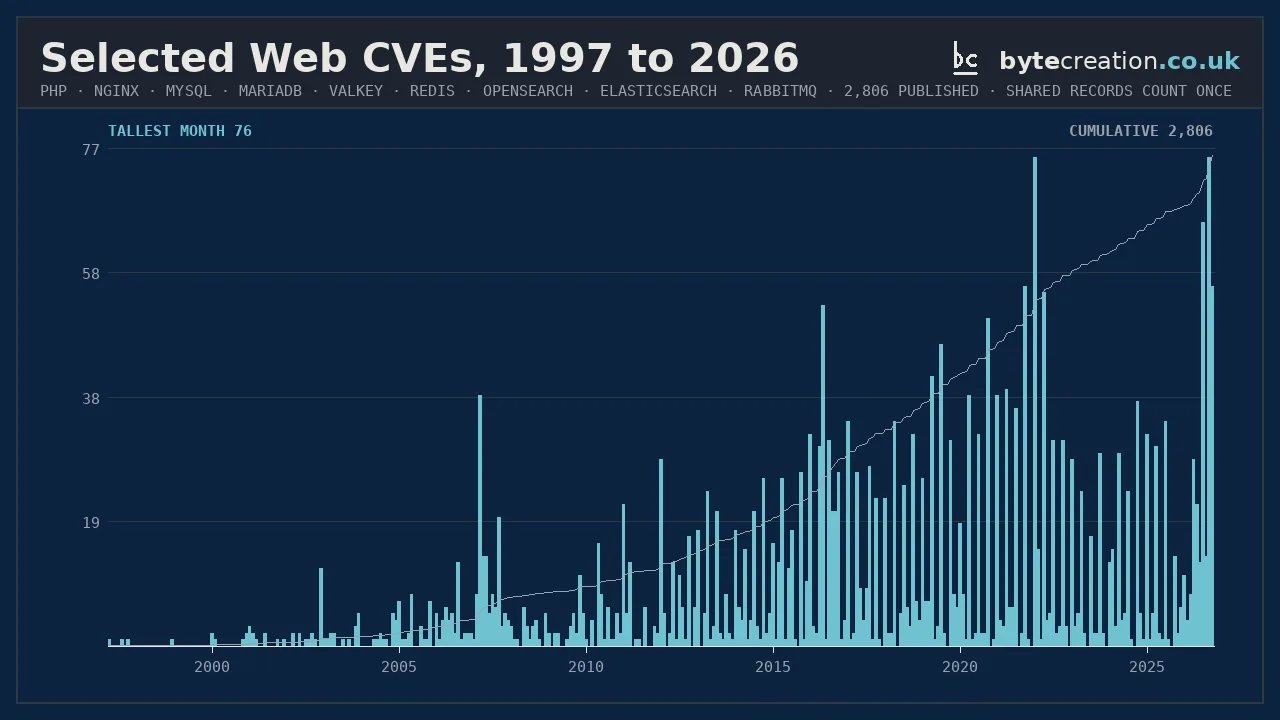
Compiled CVEs for PHP, Nginx, MySQL, MariaDB, Valkey, Redis, OpenSearch, ElasticSearch, RMQ
Peak 76 CVEs · mean 7.9 per month · hover, tap, or use the arrow keys
Peak 299 CVEs · mean 93.5 per year · hover, tap, or use the arrow keys
The nine figures above combined into one curve: 2,806 unique records, 328 fewer than the sum of the individual figures because records that name two of these products — shared MySQL and MariaDB code paths, Redis bugs that also carry Valkey criteria — count once here.
All CVEs from 1998 to 2026
Peak 17,025 CVEs · mean 1,151.1 per month · hover, tap, or use the arrow keys
Peak 89,824 CVEs · mean 13,733.4 per year · hover, tap, or use the arrow keys
The dataset is a snapshot taken late in 2026; this figure will be rebuilt at the end of 2026.
Two shape notes. The earliest year is a sentinel: the oldest records carry reconstructed 1998 publication dates, not observed ones. And the step up from 2021 to 2022 follows MITRE resuming abandoned identifier assignments at the end of 2021 plus the Log4Shell cascade; 2026 is the busiest year in the whole record, and its hottest months are the newest ones.
Show all 29 rows
| Year | CVEs | Cumulative |
|---|---|---|
| 1998 | 246 | 246 |
| 1999 | 894 | 1,140 |
| 2000 | 1,019 | 2,159 |
| 2001 | 1,676 | 3,835 |
| 2002 | 2,156 | 5,991 |
| 2003 | 1,527 | 7,518 |
| 2004 | 2,451 | 9,969 |
| 2005 | 4,932 | 14,901 |
| 2006 | 6,608 | 21,509 |
| 2007 | 6,516 | 28,025 |
| 2008 | 5,632 | 33,657 |
| 2009 | 5,732 | 39,389 |
| 2010 | 4,639 | 44,028 |
| 2011 | 4,150 | 48,178 |
| 2012 | 5,288 | 53,466 |
| 2013 | 5,187 | 58,653 |
| 2014 | 7,928 | 66,581 |
| 2015 | 6,494 | 73,075 |
| 2016 | 6,449 | 79,524 |
| 2017 | 14,642 | 94,166 |
| 2018 | 16,510 | 110,676 |
| 2019 | 17,305 | 127,981 |
| 2020 | 18,322 | 146,303 |
| 2021 | 20,149 | 166,452 |
| 2022 | 25,073 | 191,525 |
| 2023 | 28,816 | 220,341 |
| 2024 | 39,953 | 260,294 |
| 2025 | 48,151 | 308,445 |
| 2026 | 89,824 | 398,269 |
Where all CVEs from 1998 to 2026 came from
The top 50 products named by the product criteria of the records above — operating systems, browsers, distributions, applications and hardware; product families and old product names fold into one row, as the notes say. The 2026 wave isolated first, then the whole record.
Peak 4,756 records · mean 1,096.5 per product · hover, tap, or use the arrow keys
Origin of top 50 CVEs 2026
Show all 50 rows
| Rank | Product | CVEs |
|---|---|---|
| 1 | Microsoft Windows | 4,756 |
| 2 | Linux kernel | 4,535 |
| 3 | Google Chrome | 3,667 |
| 4 | Apple macOS | 2,183 |
| 5 | Google Android | 914 |
| 6 | Apple iOS | 662 |
| 7 | Mozilla Firefox | 575 |
| 8 | OpenClaw | 575 |
| 9 | Microsoft Office | 518 |
| 10 | Microsoft 365 Apps | 515 |
| 11 | Mozilla Thunderbird | 503 |
| 12 | Apple iPadOS | 474 |
| 13 | Microsoft 365 | 368 |
| 14 | Apple visionOS | 273 |
| 15 | Red Hat Enterprise Linux | 258 |
| 16 | GitLab | 250 |
| 17 | Adobe Experience Manager | 248 |
| 18 | Apple watchOS | 231 |
| 19 | Apple tvOS | 225 |
| 20 | Langflow | 200 |
| 21 | IBM AIX | 194 |
| 22 | Oracle E business suite | 180 |
| 23 | Microsoft SharePoint | 178 |
| 24 | ImageMagick | 172 |
| 25 | Freerdp | 167 |
| 26 | IBM I | 163 |
| 27 | N8N | 162 |
| 28 | Oracle Hyperion financial management | 162 |
| 29 | Qualcomm chipsets (per-chip assignments) | 152 |
| 30 | Mattermost server | 152 |
| 31 | IBM Vios | 149 |
| 32 | Openwebui Open webui | 137 |
| 33 | Microsoft Azure | 127 |
| 34 | Wwbn Avideo | 126 |
| 35 | Splunk | 122 |
| 36 | Microsoft Excel | 117 |
| 37 | Oracle Coherence | 112 |
| 38 | Mongodb | 111 |
| 39 | Wireshark | 110 |
| 40 | Oracle Helidon | 110 |
| 41 | Oracle Webcenter content | 109 |
| 42 | Dell Secure connect gateway | 106 |
| 43 | Oracle Mysql server | 106 |
| 44 | Discourse | 106 |
| 45 | Flowiseai Flowise | 106 |
| 46 | Color Iccdev | 104 |
| 47 | Microsoft Edge | 103 |
| 48 | Elastic Kibana | 102 |
| 49 | Red Hat Build of keycloak | 100 |
| 50 | Oracle Peoplesoft enterprise peopletools | 99 |
Ranking counts 2026-published kept records whose NVD product criteria name the product — 40,207 of the 89,824 records; the 49,617 without product criteria are excluded. A record naming several products counts in every row it matches, so the column sums above the record total. Editions of one product (Windows releases, macOS versions, Office suites) and old names of the same product (Mac OS X/macOS, iPhone OS/iOS) are folded into one row; Qualcomm’s practice of assigning a CVE per chipset is folded to one vendor row. The raw per-criteria counts sit in the ETL.
Origin of top 50 CVEs 1998 to 2026
Show all 50 rows
| Rank | Product | CVEs |
|---|---|---|
| 1 | Microsoft Windows | 21,853 |
| 2 | Linux kernel | 19,628 |
| 3 | Apple macOS | 12,364 |
| 4 | Debian Linux | 10,077 |
| 5 | Google Android | 9,726 |
| 6 | Google Chrome | 7,841 |
| 7 | Fedora | 5,382 |
| 8 | Apple iOS | 4,858 |
| 9 | Ubuntu | 4,193 |
| 10 | Red Hat Enterprise Linux | 4,072 |
| 11 | Mozilla Firefox | 3,586 |
| 12 | Qualcomm chipsets (per-chip assignments) | 2,555 |
| 13 | Apple iPadOS | 2,199 |
| 14 | Apple tvOS | 2,163 |
| 15 | Mozilla Thunderbird | 2,071 |
| 16 | Apple watchOS | 1,931 |
| 17 | openSUSE Leap | 1,920 |
| 18 | Adobe Acrobat DC | 1,832 |
| 19 | Adobe Acrobat Reader DC | 1,832 |
| 20 | Microsoft Internet Explorer | 1,737 |
| 21 | Microsoft Office | 1,716 |
| 22 | Apple Safari | 1,675 |
| 23 | GitLab | 1,507 |
| 24 | openSUSE | 1,467 |
| 25 | Adobe Acrobat | 1,414 |
| 26 | Oracle MySQL | 1,328 |
| 27 | Adobe Experience Manager | 1,299 |
| 28 | Adobe Acrobat Reader | 1,090 |
| 29 | Adobe Flash Player | 1,084 |
| 30 | Microsoft Edge | 1,055 |
| 31 | Huawei HarmonyOS | 1,050 |
| 32 | NetApp OnCommand Insight | 971 |
| 33 | IBM AIX | 940 |
| 34 | Microsoft 365 Apps | 936 |
| 35 | Apple iTunes | 922 |
| 36 | NetApp Active IQ Unified Manager | 848 |
| 37 | ImageMagick | 839 |
| 38 | Oracle JRE | 817 |
| 39 | Huawei EMUI | 811 |
| 40 | Oracle JDK | 809 |
| 41 | Wireshark | 795 |
| 42 | Juniper Junos | 794 |
| 43 | Oracle Solaris | 781 |
| 44 | PHP | 757 |
| 45 | SUSE Linux Enterprise | 757 |
| 46 | NetApp OnCommand Workflow Automation | 743 |
| 47 | Microsoft SharePoint | 735 |
| 48 | Drupal | 734 |
| 49 | Mozilla SeaMonkey | 707 |
| 50 | Joomla | 669 |
Ranking counts kept records whose NVD product criteria name the product — 322,811 of the 398,269 records; the 75,458 without product criteria are excluded. A record naming several products counts in every row it matches, so the column sums above the record total. Editions of one product (Windows releases, macOS versions, Office suites) and old names of the same product (Mac OS X/macOS, iPhone OS/iOS) are folded into one row; Qualcomm’s practice of assigning a CVE per chipset is folded to one vendor row. The raw per-criteria counts sit in the ETL.
Found by LLMs
Peak 11 CVEs · mean 1.4 per month · hover, tap, or use the arrow keys
Peak 24 CVEs · mean 11.7 per year · hover, tap, or use the arrow keys
This chart is a verified floor, not a census: it counts only CVEs whose own record or vendor advisory credits a named LLM tool by name. The shape is set by disclosure programmes — Google’s Big Sleep accounts for 22 of the 35, and its FFmpeg/QuickJS batches make the 2025 autumn months tallest — and aggregator trackers claim two orders of magnitude more under attribution that cannot be checked record by record. It’s unclear whether LLMs are finding more than this floor records and not being attributed.
Show all 35 rows
| CVE | Product | System | Discoverer |
|---|---|---|---|
| CVE-2024-9143 | OSS-Fuzz project | OSS-Fuzz-Gen | |
| CVE-2025-22795 | OpenSSL | Aisle Research | AISLE |
| CVE-2025-0133 | PAN-OS | XBOW | XBOW |
| CVE-2025-6965 | SQLite | Big Sleep | |
| CVE-2025-9132 | Chrome (V8) | Big Sleep | |
| CVE-2025-9478 | Chrome (ANGLE) | Big Sleep | |
| CVE-2025-9086 | curl | Big Sleep | |
| CVE-2025-59730 | FFmpeg | Big Sleep | |
| CVE-2025-59731 | FFmpeg | Big Sleep | |
| CVE-2025-59732 | FFmpeg | Big Sleep | |
| CVE-2025-59733 | FFmpeg | Big Sleep | |
| CVE-2025-59734 | FFmpeg | Big Sleep | |
| CVE-2025-11731 | libxslt | Big Sleep | |
| CVE-2025-62492 | QuickJS | Big Sleep | |
| CVE-2025-62493 | QuickJS | Big Sleep | |
| CVE-2025-62494 | QuickJS | Big Sleep | |
| CVE-2025-62495 | QuickJS | Big Sleep | |
| CVE-2025-62496 | QuickJS | Big Sleep | |
| CVE-2025-43429 | Safari | Big Sleep | |
| CVE-2025-43430 | Safari | Big Sleep | |
| CVE-2025-43431 | Safari | Big Sleep | |
| CVE-2025-43432 | Safari | Big Sleep | |
| CVE-2025-43433 | Safari | Big Sleep | |
| CVE-2025-43434 | Safari | Big Sleep | |
| CVE-2025-62497 | QuickJS | Big Sleep | |
| CVE-2025-11187 | OpenSSL | Aisle Research | AISLE |
| CVE-2025-15467 | OpenSSL | Aisle Research | AISLE |
| CVE-2025-69421 | OpenSSL | Aisle Research | AISLE |
| CVE-2025-64175 | Gogs | Aardvark (GPT-5) | OpenAI |
| CVE-2026-25242 | Gogs | Aardvark | OpenAI |
| CVE-2026-4747 | FreeBSD (NFS) | Claude (Mythos Preview) | Anthropic |
| CVE-2026-5194 | wolfSSL | Claude (Mythos Preview) | Anthropic |
| CVE-2026-101276 | iperf3 | Claude | Anthropic |
| CVE-2026-101283 | iperf3 | Claude | Anthropic |
| CVE-2026-98432 | Linux kernel (MPTCP) | Claude | Anthropic |
Links
- AI Bug Hunting and the 2026 Kernel CVE Spike, the kernel-record audit of the same wave
- Frontier LLM use in security fixes, the same wave measured through the discovery-to-fix pipeline
- the NVD query behind the PHP chart
- the whole-record monthly dataset as CSV
- The eleven monthly datasets as CSV: PHP, nginx, MySQL Server, MariaDB Server, Valkey, Redis, OpenSearch, ElasticSearch, RabbitMQ Server, compiled, found by LLMs
- Vendor advisory indexes used for the cross-checks: nginx, MySQL, MariaDB, Valkey, Redis, OpenSearch, ElasticSearch, RabbitMQ