

The claim that AI bug hunting caused the 2026 CVE spike is in the press and being talked about in software development teams. Other articles also examine this such as Narrative Vs Reality of 2026 CVE Apocalypse which explores if the narrative is supported by evidence when it comes to selected web services (it’s not). The article Frontier LLM use in security fixes examines several studies presented by what’s been allegedly happening on the frontier and in labs to see if the reported impact can be seen there (LLMs can help in particular cases and impact is currently low ad dependent on the task).
For this article we explore public Linux Kernel CVEs and analyse the data to see if we can see LLM impact. Something is measurably happening, but it’s not the narrative currently in the press.
So what is actually happening with the volume of CVEs increasing?
However, in the background something is actually happening with the use of LLMs and it does show up in the data. And LLMs are being used for more than just finding issues and submitting code changes.
Also in the press is the counter narrative to the AI lab companies that LLMs are producing high volumes of slop. We can also see this in the research for this article as the maintainers themselves have had to setup new processes and automated tools to manage the volume of new LLM generated submissions.
Let’s dive into the data.
Linux kernel CVEs by week
Peak 1,215 CVEs · mean 186.4 per week · hover, tap, or use the arrow keys
CVEs: 8,202LLM-disclosed CVEs: 1,143
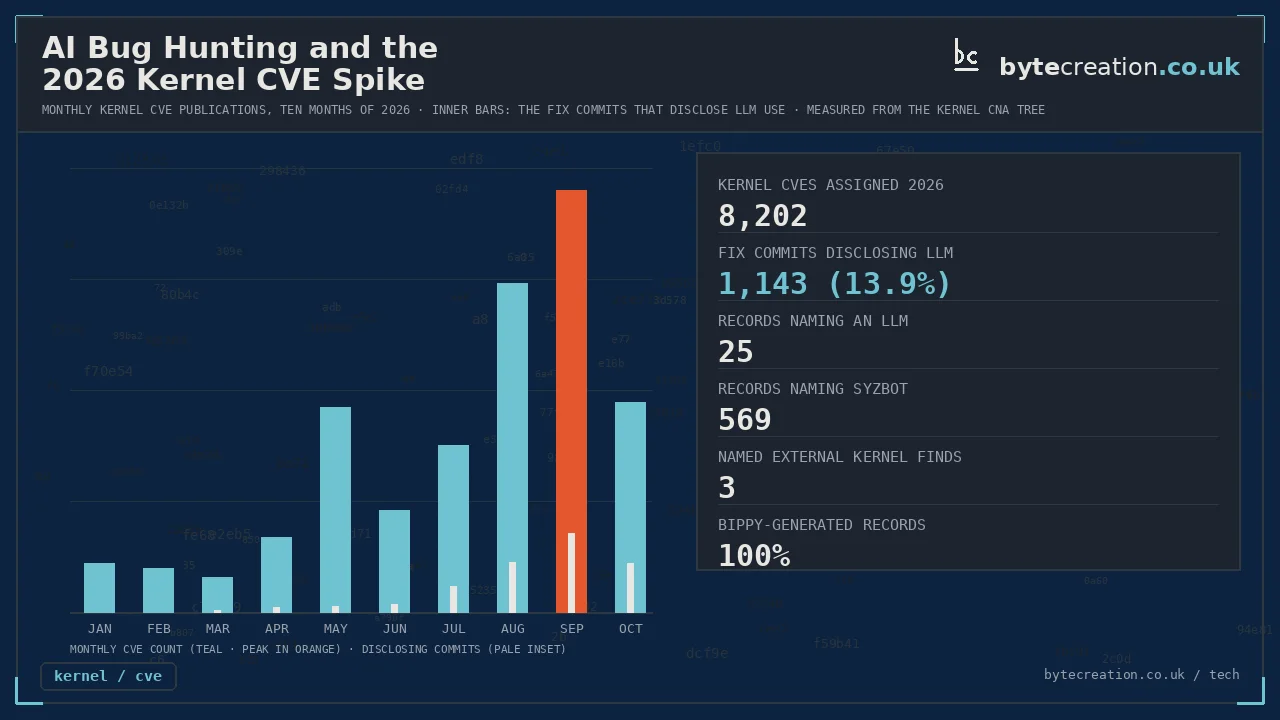
The same 8,202 records in ISO weeks (Monday to Sunday) from W01 to W44. The bars carry the peak of the surge: 1,215 records in the busiest week. The inset is the disclosure subset: records whose named fix commit declares LLM use in its own message, 1,143 of the 8,202, a 14% share; it peaks in the same week at 179. CVEs are assigned in batches when fixes land in a supported stable branch, so one release week publishes hundreds at once.
The weekly split answers the human question at its widest defensible width: at least 86% of 2026 fixes carry no LLM disclosure of any kind, human-led work running through the ordinary pipeline, and 14% that declare assistance.
The record text draws the line sharper: 97.3% of records credit no model and no model-driven tool, 2.7% credit an LLM or the LLM-driven sashiko review bot, and 0.4% name a model with the finding. None is fully LLM-resolved. The closest credits name a model writing part of the fix, with a human reporting or reviewing the bug in every case: a Sonnet co-developed, a Claude credited with parts written, a Claude draft, a Qwen patch adopted. The record, the version range and the announcement stay the pipeline’s doing in all of them.
While LLM involvement of course may not be declared for every issue. We can see that LLM use data is being recorded for many issues and this is what we’re measuring.
What the records disclose
| Year | Published records (ID-year) | Credited to an LLM in record text | Credited to syzbot |
|---|---|---|---|
| 2023 | 1,616 | 0 | 170 |
| 2024 | 3,064 | 0 | 306 |
| 2025 | 2,667 | 0 | 286 |
| 2026 | 7,945 | 30 | 230 |
Three readings matter. The traditional automation still out-credits the LLMs in absolute terms: syzbot is named in 230 records, the LLMs in 30, a ratio of nearly 8 to 1. The LLM credits are also entirely new: no record in any earlier year carries one (obviously, with it being a new technology), and all thirty sit in the 2026 tree. And because every 2026 record is generated by bippy from a merged fix, the CVE count tracks fix throughput: the AI effect enters through report inflow (more fixes merged) and the pipeline turns each fix into a record automatically.
Ten years of mainline code changes
Peak 11,074 commits · mean 6,618.2 per month · hover, tap, or use the arrow keys
Peak 84,780 commits · mean 78,215.5 per year · hover, tap, or use the arrow keys
commits: 860,370LLM-disclosed commits: 6,410
The bars are the code changes that reached mainline: non-merge commits bucketed on the date they were merged, 860,370 of them across ten complete years and the current one. The inset is the same disclosure subset as the weekly figure above: 6,410 commits whose own message discloses LLM use. The shape is flat for nine years and steep in the tenth. Across 2016 to 2025 the disclosure rule finds 3 commits in the whole of mainline; 6,407 sit in the current year alone. The busiest year for change was 2023, at 84,780 commits. The disclosure signal arrives at the end of a decade-long climb in merge volume, and the fix-commit record carries no pre-2026 baseline to measure a 13.9% share against.
Named in the record
The in-record credits span CVE-2026-23194 to CVE-2026-99164 and cluster in the highest-numbered range: 9 of 30 sit above CVE-2026-97000. The credits, quoted from the CNA description text:
Show all 30 rows
| CVE | What the record says | Tool named |
|---|---|---|
| CVE-2026-23194 | “the root cause of this bug was diagnosed by Gemini CLI on first try” | Gemini CLI |
| CVE-2026-23309 | “found by an experimental code review agent based on gemini-3.1-pro while reviewing backports” | Gemini 3.1 Pro agent |
| CVE-2026-31504 | “audit with Claude Code based on CVE-2025-38617” | Claude Code |
| CVE-2026-31552 | “the problem was found by an experimental code review agent based on gemini-3.1-pro” | Gemini 3.1 Pro agent |
| CVE-2026-31554 | “his LLM found it” | LLM (unnamed) |
| CVE-2026-31580 | “tell all details to the QWEN and adopted the modifications it made” | Qwen |
| CVE-2026-31621 | “LLM tools read documentation better than humans” | LLM (unnamed) |
| CVE-2026-31689 | “found by Claude while reviewing another EDAC patch” | Claude |
| CVE-2026-31730 | “static checks, with LLM assistance for triage” | LLM (unnamed) |
| CVE-2026-31735 | “Claude deduced the root cause” | Claude |
| CVE-2026-43067 | “a review bot running on the latest Gemini LLM” flagged it during an LTS backport | Gemini |
| CVE-2026-43193 | “Claude pointed out that there is a reference leak” | Claude |
| CVE-2026-45920 | “an LLM scan of the resulting output identified the cause” | LLM (unnamed) |
| CVE-2026-46294 | “found a buffer overflow in ioctl processing” (with Claude) | Claude |
| CVE-2026-53121 | “discovered by Claude Opus 4.6 with the aid of Chris Mason’s review-prompts” | Claude Opus 4.6 |
| CVE-2026-53378 | “Co-developed by Claude Sonnet 4.5” | Claude Sonnet 4.5 |
| CVE-2026-68456 | “the latter two were written by Claude” | Claude |
| CVE-2026-74463 | “Assisted-by web based Google AI” | Google AI |
| CVE-2026-74630 | “found and triaged by OpenAI Security Research and validated by Trail of Bits” | OpenAI |
| CVE-2026-89553 | “spotted with the help of Opus 4.6” | Claude Opus 4.6 |
| CVE-2026-93787 | “the fix below was drafted with the Claude coding assistant” | Claude |
| CVE-2026-97976 | “reported by Claude Mythos” | Claude Mythos |
| CVE-2026-98291 | “reported by Claude Mythos” | Claude Mythos |
| CVE-2026-98392 | “Claude Mythos” | Claude Mythos |
| CVE-2026-98819 | “was reported by Claude Mythos” | Claude Mythos |
| CVE-2026-98873 | “occasional LLM hints wrt. leaking” | LLM (unnamed) |
| CVE-2026-99042 | “found by an AI coding assistant (Claude Code)” | Claude Code |
| CVE-2026-99046 | “this issue was caught by LLM” | LLM (unnamed) |
| CVE-2026-99062 | “found during an LLM-assisted manual source audit” | LLM (unnamed) |
| CVE-2026-99164 | “an LLM was used to identify the size mismatch” | LLM (unnamed) |
Fifteen of the thirty name an Anthropic model (four carry the Claude Mythos preview name, plus two Opus 4.6 credits, a Sonnet 4.5, and two Claude Code credits), eight use the generic LLM wording, and the remainder name Gemini tooling, Qwen, a Google assistant, or OpenAI’s security research arm. Three credits describe authorship rather than discovery: CVE-2026-53378 was co-developed with a model, CVE-2026-68456’s fix text says parts were written by Claude, and CVE-2026-93787’s fix “was drafted with the Claude coding assistant” after a KASAN report found the bug.
The highest-profile AI-found kernel CVEs carry no such credit. CVE-2026-98432, a use-after-free in the TCP syn_recv_sock path rated 9.8, is described as Claude’s find in Anthropic’s disclosure; the record itself contains no mention of any tool. CVE-2026-31402, a remotely triggerable NFSv4.0 replay-cache overflow, was published with its full chain by Anthropic’s safety work and covered with maintainer comment; the record is silent. CVE-2025-37899, the ksmbd remote use-after-free long treated as the first public LLM-discovered kernel zero-day, was documented in the write-up “How I used o3 to find CVE-2025-37899, a remote zero-day vulnerability in the Linux kernel’s SMB implementation” and its fix commit credits nothing beyond the human reporters. The sanitisation pattern is real: it is the record, not the disclosure, that carries the clean text.
This confirmed our earlier concern that disclosure of LLM use is not always declared. The numbers in reality are probably larger to an unknown degree. How we get this measure currently is unknown.
Who the fix commits credit
The weekly inset counts 1,143 records whose fix commit declares LLM help. The same reading across the whole year, one credit tier per commit in precedence order, shows what that layer is made of. Every published record with a 2026-series ID resolves to a mainline fixing commit through the version range in its own affected block: 7,942 of 7,945 resolve. The tiers run: a model named, a researcher at an AI lab with no model named, the sashiko review bot, syzbot, a static analyser or test robot, a named human reporter, nothing.
| Credit in the merged fix commit | Records | Share of 7,942 |
|---|---|---|
| none | 4,562 | 57.4% |
| a model named | 1,018 | 12.8% |
| a named human reporter | 885 | 11.1% |
| a static analyser or test robot | 560 | 7.1% |
| the sashiko review bot | 449 | 5.7% |
| syzbot or syzkaller | 417 | 5.3% |
| a researcher at an AI lab, no model named | 51 | 0.6% |
The model credits are mostly credits for writing, not for finding. Of the 1,018 commits naming a model, 982 name it in an Assisted-by: line, 14 name it in a Reported-by: line as the finder, and 22 credit it in prose with no credit line at all. Across the year that is 70 credits for authorship help per credit for discovery, the opposite of how the claim is usually phrased. Three commits go further and say a model wrote part of the fix: CVE-2026-53378 (“Co-developed by Claude Sonnet 4.5”), CVE-2026-68456 (“The latter two were written by Claude”), and CVE-2026-31580, where the author took the modifications a Qwen model proposed. No commit in the year claims a fix written entirely by a model. A fourth credit, CVE-2026-93787, reaches the record text rather than the commit message, where only Assisted-by: survives.
Silence is the largest tier and it carries no meaning. A Reported-by: line is a courtesy in kernel practice rather than a requirement, so the 57.4% that credit nobody cannot technically be read as human discovery, and the honest statement is a floor: at least 87.2% of the year’s joined fix commits make no claim about a model at all.
This pass reads 1,018 of 7,945 records, 12.8%, where the weekly inset reads 1,143 of 8,202, 13.9%. The gap is cohort plus filtering. The inset buckets on publication date and takes a token match at face value; this pass buckets on the CVE ID year and removes three classes of false positive: three records whose only match is the Marvell gemini gigabit ethernet driver, a maintainer’s aside that “LLM tools read documentation better than humans”, and the work addresses of researchers at AI labs, @openai.com and @anthropic.com, which credit a person rather than a model. The two figures bound the same layer from either side, and neither one measures how the bug was found.
Where each year’s records come from
The same tree lets every record from 2020 to 2026 be banded by what its own text credits, so the rise can be attributed rather than asserted. The bands are mutually exclusive by precedence: a record naming an LLM counts there even if it also names a fuzzer; then the sashiko review bot; then fuzzing; then static analysis; the pipeline band is the residue — a record generated for a merged fix that credits no discovery tool. The yearly totals are the tree’s own ID-year counts: 17, 731, 2,122, 1,616, 3,064, 2,667, and 7,945.
Peak 7,945 CVE records · mean 2,594.6 per year · hover, tap, or use the arrow keys
fix pipeline: 16,248syzbot fuzzing: 1,262static analysis: 436sashiko review bot: 186LLM credit: 30
| Year | Fix pipeline | syzbot fuzzing | Static analysis | Sashiko review bot | LLM named |
|---|---|---|---|---|---|
| 2020 | 17 | 0 | 0 | 0 | 0 |
| 2021 | 624 | 83 | 24 | 0 | 0 |
| 2022 | 1,901 | 189 | 32 | 0 | 0 |
| 2023 | 1,418 | 170 | 28 | 0 | 0 |
| 2024 | 2,637 | 306 | 121 | 0 | 0 |
| 2025 | 2,343 | 286 | 38 | 0 | 0 |
| 2026 | 7,308 | 228 | 193 | 186 | 30 |
The rise lives in the pipeline band, not in any discovery band. Of the 5,278 records 2026 adds over 2025, 4,965 — 94% of the increase — credit no discovery tool at all: a fix merged into a supported branch and a record generated for it. The kernel’s own process page is blunt about why that band is the big one: “the CVE assignment team is overly cautious and assign CVE numbers to any bugfix that they identify. This explains the seemingly large number of CVEs” (the CVE process document). The project has been its own numbering authority since 2024, and the document describes assignment as automatic once a fix reaches a stable tree, which is exactly the shape the figure shows: the pipeline band grows with fix volume, and 2026’s fix volume was set by the report inflow the previous section measured.
Fuzzing, the automation that predates language models, did not grow. syzkaller appeared in 2015 and its reporting bot syzbot has filed findings to the lists since 2017; its own retrospective counts over 5,570 bugs reported across continuous mainline fuzzing. Records naming syzbot peaked in 2024 at 306 and stand at 230 in 2026: the count is flat to down while its share of all records collapsed, from about one in nine in 2021–2025 to one in thirty-five in 2026. The fuzzer did not shrink the pool of findings; the denominator tripled around it. The static-analyser band, long the smallest at one to four percent of records, likewise moves from 38 records in 2025 to 193 in 2026 without changing the shape of the year.
The genuinely new credit bands both arrive in 2026, and both are automated review rather than named discovery. Sashiko is an agentic patch-review system announced on the kernel mailing list early in 2026, built by Google engineers with ownership transferred to the Linux Foundation and running on commercial language models. Maintainers and committers quote its reports inside fix messages — “Sashiko AI has reported that…” — and fix messages become CVE descriptions, which is how the credit lands in 186 records. So the defensible reading of the 2026 bands is not “LLMs found 30 CVEs”: it is 30 records crediting a model with finding or analysing the bug, 186 crediting an LLM-driven review bot by its own name, and 92% crediting the fix pipeline and nothing else. Even summed, the two model-adjacent bands cover 216 of 7,945 records, 2.7% of the year. The category change — a self-assigning CNA that deliberately over-assigns, a review bot newly wired into the fix pipeline, and a static-analysis uptick — accounts for the spike; credited LLM discovery accounts for 0.4%.
But we know that LLM disclosure doesn’t always occur for each issue. But how much they contributed is unknown and relying on Anthropic press releases as a primary source of high quality information is probably unwise, given the inentives.
Outside claims, graded
| Source | Claim | Verifiable CVE evidence | Verdict |
|---|---|---|---|
| Anthropic | a model found CVE-2026-98432 (kernel), plus 62 Chrome CVEs and a Windows QUIC bug | named and resolvable | strong |
| Anthropic zero-days report | Claude Opus 4.6 found 500+ high-severity vulnerabilities, kernel crashes included, human-validated | three named examples, no ledger | moderate |
| Anthropic safety work (via mtlynch) | five kernel bugs including CVE-2026-31402 | named and resolvable | strong |
| OpenAI o3 write-up | CVE-2025-37899 found with o3 assist | named and resolvable | strong |
| OpenAI Aardvark | ten open-source findings received CVE IDs | count asserted, no list | moderate |
| Google Big Sleep | first AI agent to pre-empt in-the-wild exploitation | CVE-2025-6965, SQLite, not kernel | strong, off-kernel |
| DARPA AIxCC | cyber-reasoning systems found 54 of 63 synthetic and 18 real open-source bugs | independently scored | strong, zero kernel CVEs |
| Mandiant AVDH | 100+ verified flaws in a 48-hour engagement | no CVE ledger | marketing-grade |
| CrowdStrike “AI-driven surge” | press framing of a collapsed patch window | no CVE attribution | marketing |
Three named, resolvable kernel CVEs survive external verification: the three above, all of them human-and-model hybrids where a human or lab validated the finding and submitted it. The larger claims (500+ crashes under review, a thousand flaws per engagement) are not checkable from outside, and the vendor press wave carries no ledgers at all.
What the lists recorded
The maintainer record is where the surge is visible without any attribution layer at all. Willy Tarreau’s log of the kernel security list: 2 to 3 reports per week two years back, about 10 per week of “AI slop” last year, then 5 to 10 per day, most of them correct, with the flood detailed on LWN and its quality turn analysed in the follow-up. Greg Kroah-Hartman’s CVE team went from about 50 fixes per week to 33 CVEs per day (Kernel Recipes account, LWN report); per-release CVE counts moved from about 500 to nearly 2,000 by Linux 7.2. His audit of one AI bug-hunt report is the cleanest quality measurement available: of 79 reported vulnerabilities, 10 became real fixes; 24 carried no detail, 14 were not bugs, 3 presented invented data, and 15 had already been fixed, 11 of them scraped from public lists. Linus Torvalds said in the 7.1-rc4 announcement that the reports made the security list “almost entirely unmanageable” with duplicated findings from identical tools, and the project’s lead has since landed his own LLM-assisted series with cover-letter disclosure. Networking maintainers report a third to a half of incoming patches as AI-driven and the subsystem’s contributor docs now tell submitters to run LLM review before posting.
Attribution practice moved twice and then moved back. The Assisted-by: trailer was introduced after the 2025 Maintainers Summit (policy); it appeared on 301 commits in Linux 7.1 and 1,111 in 7.2; then the mandatory disclosure requirement was dropped after the 2026 summit (Phoronix), and at least one maintainer strips the trailers on application. The only in-band signal for AI involvement is being retired.
What the fixes were fixing
One more record was analysed: what the merged fixes were repairing. The kernel CNA files no CWE on any of the 8,202 records, but each record’s description is the fix commit’s own subject and message, so the fault class is readable from the fix text itself. A single classifier runs every record through the same ordered rules, first match decides; 7,423 records (90.5%) land in a class and the 779 whose text matches no rule keep their own slice. Memory safety is the largest slice, 2,334 records, 28.5%.
8,202 CVEs · hover, tap, or use the arrow keys
Why is this data here? Because it’s interesting while we had all this data to hand. It doesn’t contain any insights about LLM assistance so we’ll move on.
Reconciling the counts
Three floors answer the same question at three layers: 0.4% of 2026 records name an LLM in their own text, 2.7% once the sashiko review bot’s model-written analysis is counted alongside them; 13.9% name a fix commit that discloses LLM use; and three CVEs are named by external disclosure. The gap between 0.4% and 13.9% is an attribution gap, not a contradiction: the CVE record copies only part of the fix commit’s message, the trailer that carried the disclosure was always optional and is now dropped, and the flagship findings sanitise their records. The defensible ceiling is the 13.9%, and even that measures disclosure in fix messages, not discovery method. Inside that ceiling the credit is for the patch rather than the finding: on the record-year cohort 982 of the 1,018 commits naming a model name it in an Assisted-by: line, 14 name it in a Reported-by: line, and none claims a fix written entirely by a model. No field in the official CVE metadata distinguishes an LLM finding from a syzkaller finding: the pipeline assigns a record to every merged fix, whatever found it.
Verdict
- The audit is real and running: Anthropic, OpenAI’s security research arm, Google tooling in maintainer hands, and model-driven review bots in backport pipelines are all documented finding kernel bugs in record text or verified disclosure.
- The driver of the count is still the pipeline: 94% of the records 2026 adds over 2025 credit no discovery tool at all, every record is bippy-generated from a merged fix, and syzbot out-credits LLMs nearly 8 to 1 in named credit.
- Where a model is credited in a fix commit, it is usually credited for writing: 982 patch-text credits against 14 credits for the finding across the year’s joined commits, three commits naming a model as co-author of the fix, and no commit claiming a fix written entirely by a model.
- The genuinely new bands are automated review, not credited discovery: the sashiko bot and named-LLM credits together cover 216 of 7,945 records in 2026, and sashiko’s own reviews run on commercial models.
- The surge is report inflow turning into fix throughput: 2-3 reports per week to 5-10 per day on the security list, and 50 fixes per week to 33 CVEs per day on the stable side.
- The marketing outruns the ledger: the only externally verifiable AI-found kernel CVEs number three, and the largest vendor claims ship no CVEs at all.
Method
Four surfaces, measured against a local clone of the kernel CNA’s public tree (security/vulns.git at git.kernel.org).
Volume. Every published record under cve/published/, bucketed by CVE ID year. The current clone carries 7,945 records with 2026-series IDs, and every one of them reports "x_generator": "bippy-1.2.0": the CVE team’s own record generator. The count is a floor: the assigner’s own query (8,202) and the tree’s publication trail (8,240) both sit above it because they bucket on publication date rather than ID year.
Fix commits. The join behind the 13.9%. Each record names its fixing commits in the version range of its affected block — the lessThan SHAs, the same pairs the record’s .dyad file carries — and those SHAs are resolved against a complete clone of the mainline tree. The merged commit message is then read for the disclosure the kernel’s coding-assistants policy asks for: Assisted-by:, Co-developed-by: and Generated-by: trailers naming a model, or prose that credits one. 1,143 of the 8,202 records bucketed on publication date resolve to a mainline commit carrying such a disclosure. The trailer was always a courtesy rather than a requirement, and the line asking for it has since left the policy document, so the share is a floor, and it measures what a commit says rather than how a bug was found.
The credit tiers re-read the same join on the ID-year cohort, one tier per CVE in precedence order: a model named, a researcher at an AI lab with no model named, the sashiko bot, syzbot, a static analyser or test robot, a named human reporter, nothing. A model counts only where it is credited: email addresses at AI-lab domains are stripped before matching, so a person’s work address is a person credit, and a bare “LLM” or “AI” counts only beside a credit verb, which keeps asides out of the tally. The Marvell gemini gigabit ethernet driver and its patch-link subjects are excluded, the same family of false positive the record-text scan filters. Each surviving credit is then read for shape: a Reported-by:/Found-by: line naming a model credits the finding, an Assisted-by:/Co-developed-by:/Generated-by: line credits the patch text, and prose with neither trailer is reported separately. Authorship claims are matched on their own words (“co-developed by”, “written by”, “generated by”, “adopted the modifications”), and a separate pass looks for any commit claiming a fix written entirely by a model. The audit trail is fix_disclosure.py in the same analysis directory as the record scan.
Record text. A scan of the CNA description text for a named LLM: Claude, Gemini, OpenAI, Qwen, or the generic LLM wording. Known false positives are filtered: the cortina gemini ethernet driver and its Gemini/SL351x SoC write-ups, and GUID Partition Table code where gpt is a filesystem structure. Static analysers and fuzzers named in records (Coccinelle, smatch, sparse, KASAN, syzkaller) are not counted as LLMs, the same exclusion applied to commit trailers.
A control. Records crediting syzbot or syzkaller by name, so the LLM tally is read against the traditional automation it is usually conflated with.
Bippy. Every 2026 record carries "x_generator": "bippy-1.2.0", so it is worth defining. bippy is the CVE team’s record generator, not an analyst: a tool that takes the git SHA of a merged fix and produces the two artefacts of an assignment, the CVE record (JSON) and its announcement mail (mbox). Greg Kroah-Hartman wrote the original shell version in 2024; Sasha Levin rebuilt it as a Rust core in 2025, and its own header defines it as generating “the CVE record (.json) and announcement mail (.mbox) for a kernel CVE”. The decision of whether a fix earns a CVE at all sits upstream of the generator: the team’s tooling screens candidate stable-tree fixes for security relevance, and the assigners put a two-of-three vote behind the call (the kernel’s own CVE process document, LWN’s account of the process). bippy’s policy module then encodes the record’s shape: the affected version range implied by the vulnerable-commit/fix-commit pair, and the standing rule that one fix backported into two branches does not earn a second record.
External claims are checked by resolving every CVE ID a disclosure names: a claim counts as evidenced when the CVE exists, the disclosure attributes discovery to the tooling, and the attribution can be located. Mailing-list evidence comes from the public archives and their coverage.
Links
- Narrative Vs Reality of 2026 CVE Apocalypse, the global context
- Frontier LLM use in security fixes, the same wave measured through the discovery-to-fix pipeline
- Anthropic: Discovering vulnerabilities with Claude · zero-days report
- CVE-2026-98432 · CVE-2026-31402 · CVE-2025-37899
- LWN: Significant raise of reports · A flood of useful security reports · Coping with the onslaught of kernel security bugs
- Kernel CVEs are Alive (talk) · kernel CVE process · coding assistants policy
- sashiko: the review bot in the pipeline · sashiko announcement (LKML) · sashiko metrics · syzbot retrospective (arXiv)
- syzkaller upstream dashboard · CVE Program metrics