

There is a video doing the rounds — I Read the Research on AI Hacking. The Bubble Is Finally Dying. from the House of El: AI channel, up in the first days of November and just under 440k views behind it. It strings together a dozen primary sources: two industry reports, one vendor filing, one security-firm disclosure wave, and six arXiv preprints, to examine the claim that frontier models have moved from finding vulnerabilities to fixing them.
The video is great and worth watching in its own right. It’s perfect to close the topic being researched, alongside other articles diving into this topic (this article makes some comments about the video — which is very good — and there’s no beef here, only data. If anything here is wrong, flag it for correction). Narrative vs Reality of the 2026 CVE Apocalypse looks at web services to see if the LLM bug finding apocalypse has arrived (it hasn’t), and AI Bug Hunting and the 2026 Kernel CVE Spike sees if the high volume of Linux Kernel CVEs is down to LLMs finding so many more vulnerabilities (it isn’t, but LLMs are playing a part)
In this article we go through every source the video cites, and cross-check the numbers against independent counts where they exist.
The take away findings are interesting. LLMs are playing a part in software development. LLMs are tools and come with limitations. They are useful in particular situations.
Let’s get into the data.
The year disclosure doubled
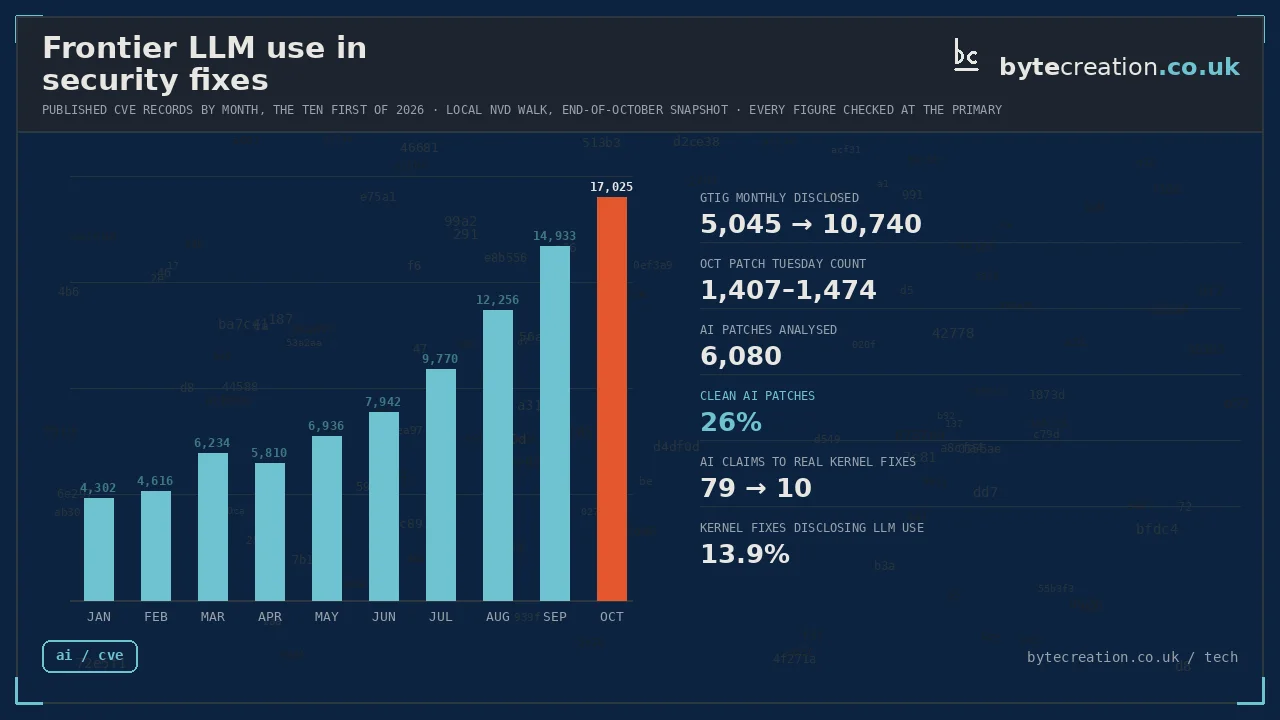
Google’s Threat Intelligence Group published Vulnerability Discovery and Exploitation Trends in the AI Era at the end of September. The figure the video quotes is accurate and it is a monthly one: Google’s filtered count of disclosed vulnerabilities ran from 5,045 in January to 10,477 in July, peaking at 10,740 in August — a 2.13× rise, “more than doubled” without rounding tricks. Independent counters agree on the shape: the CVE Program’s own list ran 5,923 in March to 12,254 in August and 14,930 in September; the local NVD walk, an end-of-October snapshot, ran 12,256 in August, 14,933 in September, and 17,025 in October. Year-to-date totals sit between 67,000 (CISA, projecting 96,000 for the full year) and 89,824 on that walk.
Peak 17,025 CVEs · mean 1,151.1 per month · hover, tap, or use the arrow keys
Peak 89,824 CVEs · mean 13,733.4 per year · hover, tap, or use the arrow keys
The walk behind the claim in full: 398,269 published records, 1998 to 2026, bucketed on publish month. Before 2016 the monthly mean is 338; 2016 delivered 6,449 for the whole year, 2025 delivered 48,151, and the first ten months of 2026 reach 89,824 — 4,302 in January, 17,025 in October.
What is easy to miss is that GTIG does not attribute the disclosure doubling to AI. The report says the baseline itself is inflated by automated CNA assignment policies in open source, by consumer-router mass disclosures, and by kernel bulk assignment: descriptions containing the words “Linux Kernel” alone generated about 5,000 CVEs in the first eight months, with zero exploited in the wild.
Where GTIG does credit AI is the exploitation side, and there the curve also climbs: average exploited vulnerabilities per month nearly doubled, from 10.5 in 2025 to 18 across the first eight months of 2026, with 141 distinct exploited vulnerabilities already out-running 2025’s full-year 127. High-risk exploitation tripled (28 to 75). The detail that splits the AI-found CVEs from the rest: half enable remote code execution, against 26% for the others — whatever models are finding, it skews toward the severe end. GTIG’s named mechanism is faster n-day weaponization — models turning published patches and diffs into working exploits — not a surge of model-found zero-days. It tracks 2,076 AI-related CVEs since early 2025 and reports no observed zero-day exploitation of AI infrastructure itself.
What none of these counts captures is the bug hunts that started with an LLM and were quietly abandoned. The lab studies count attempts at a task — 1Password’s 6,480 patch runs, for instance — but the disclosure wave keeps tallies of findings, never of tries that went nowhere, so abandoned hunts leave no trace in any dataset. The one measured window into that failure rate sits on the receiving side: when the kernel’s CVE lead audited one AI bug-hunt’s reports, 79 claimed vulnerabilities became 10 real fixes — 24 carried no detail, 14 were not bugs, 3 rested on invented data, and 15 had already been fixed (the sister article walks that audit). My own experience of using LLMs for bug work matches the shape of it: strong at particular things, not great at others and work does need to be abandoned sometimes. What’s not being measured at scale is how many LLM attempts to fix something produce nothing meaningful, waste time, and never surface in a CVE record.
A record Patch Tuesday, with an AI asterisk
Microsoft’s October batch — the MSRC release note of the second Tuesday — set the second consecutive monthly record: more than 1,400 vulnerabilities in a single Patch Tuesday, after roughly 1,000 in September. The exact count depends on who is counting: 1,407 (Tenable), 1,413 (SecurityWeek), 1,411 (BleepingComputer), 1,417 (SANS), and Microsoft’s own page header says 1,474 while its table sums lower. One zero-day was exploited in the wild — CVE-2026-96951, a Mark-of-the-Web bypass in the Windows shell, CVSS 8.8, onto CISA’s KEV within three days — and a .NET WDAC bypass (CVE-2026-108398) was publicly disclosed before the fix shipped.
Peak 1,415 CVEs · mean 129.5 per month · hover, tap, or use the arrow keys
Peak 4,169 CVEs · mean 1,510.7 per year · hover, tap, or use the arrow keys
The same test on the Microsoft side: 9,064 Microsoft-assigned CVEs across 70 release months since 2021. No month from 2021 through 2025 exceeds 177; then 2026 runs 621 in July, 398 in August, 972 in September, and 1,415 in October, release-document counts throughout.
The video’s claim that Microsoft “directly credits AI” needs the asterisk. Microsoft has credited large language models for discovery volume — Windows vice president Pavan Davuluri said it on the record in July: “As AI helps defenders discover more issues, customers will see a higher volume of security updates” — and the October coverage reports the surge as largely AI-driven, but a named-tool attribution for the October batch specifically could not be found.
Two structural features of the AI attribution argue for caution. Microsoft is the CNA for its own CVEs and sells Copilot: the count, the AI credit, and the product line marketed on that capability all come from one vendor, and no independent ledger of the underlying discovery work exists. And a patch count measures findings, which depend on how closely the code was read before: closed-source code is not combed line by line by outsiders, so a first-party automated pass (LLM or otherwise) surfaces more of a backlog in one go than the same pass over a library the public has audited for decades. “Better discovery” and “automation finally combing a private codebase’s legacy backlog” are both consistent with 1,415 records, and the release note separates neither. The story might be that private codebases benefit more from LLMs than open source, as ancient or committee-based code is scrutinised by a vigorous pattern matcher. Specualiton, but it would fit the data.
PHP2Shell: a decade-dormant bug, found by models, exploited before disclosure
The incident the video treats as its spine sits in this site’s own patch history. Two PHP memory-corruption vulnerabilities — CVE-2026-109618 and CVE-2026-109619, both CVSS 9.2 — let an unauthenticated request reach remote code execution. The first: an out-of-memory fatal path where longjmp() leaves request memory uninitialized and the shutdown cleanup reads it. The second: request-owned global state surviving its own free, reused by the next request on the same worker, via a fatal-error backtrace use-after-free compounded by an OPcache type confusion. Everything from PHP 5.4.0 through 8.5.11 was affected — which is why Wiz Research’s write-up titled the class “affecting 70% of the Internet.”
The discovery record supports the video’s “dormant for over a decade” line better than most claims of that shape. Calif found the first path on 1 August, tracing the bug’s lineage through PHP 5.4 (2012) and further back to a 2004 change. Wiz found its own PHP bug on 19 August and confirmed unauthenticated RCE against Drupal and WordPress installs on 20–21 August. Wiz credits its Atlas tooling with Gemini 4 Argon and GPT-5.6 Sol, saying the model “made an invaluable contribution”; Calif’s researcher, working under OpenAI’s Patch the Planet programme, is the more useful quote: no special harness, only generally available models, but “know your target” still applies, and “no model is simply capable of unearthing ‘all bugs’ with simple prompts.” The coordinated fix landed 21 October as 8.5.12 / 8.4.27 / 8.3.36 / 8.2.35, same-day with disclosure; a third related CVE (CVE-2026-115560) surfaced two days after the fixes, still unpatched at disclosure, mitigated by disabling session.upload_progress (arguably doesn’t fix it, by the way).
The timeline’s other edge runs earlier. AWS Threat Intelligence logged a PHP2Shell exploitation attempt from anonymized infrastructure on 17 October — four days before disclosure. After the leak, Fastly measured roughly 250,000 exploit-scan requests from about 3,200 IPs, with kits branding the CVE in the User-Agent. By the end of the month Unit 42 had found the chain in the wild against exposed PAN-OS management interfaces, chained to a kernel privilege-escalation for root. CISA’s KEV entry landed on 26 October, five days after the patch. One video-adjacent claim to drop: no source documents ransomware use — the activity is mass scanning and targeted chaining, not ransomware campaigns.
Discovery to patch took seven to ten weeks of coordination. Discovery to first exploitation attempt, unknown to the vendors, took under eleven weeks of silence. The models were not the bottleneck.
The fix problem: three of four patches leave something broken
The video’s two patch-quality figures both hold up against the primaries. One needs precision.
1Password’s research group, Off-by-1 Labs, published Frontier Models’ Vulnerability Patches are Often F.L.A.W.E.D. in early August (the acronym names the artifact type — Fix-Like Artifacts with Embedded Defects — not a per-letter taxonomy; the failure classes run as scenarios S1–S5, harness and datasets on GitHub). They ran 6,480 patch attempts on frontier models and analysed 6,080 of them. 26% were clean — call it three in four patches leaving something broken: the vulnerability still reachable, the fix a symptom-silencer, or the fix introducing new defects. The companion post is blunt that this is why “AI-generated patches still require human review.” The video skips a counter-argument: Trail of Bits published a rebuttal two weeks later arguing the 26% figure is a misleading guide to ordinary patching work — an attack worth knowing about before quoting either number as settled.
The Northwestern study the video cites — Le, Shi and Xing, On the Reliability of LLM-Based Vulnerability Patching Benchmarks, October — is where the “61%” needs its precision. The team ran 112 real vulnerabilities across 84 open-source projects in C, C++, Go and Rust through three oracles: does the proof-of-concept stop crashing (PoC), do the project’s existing tests still pass (regression), and does the patch match what the maintainer’s own fix commit did (the paper’s “developer’s tests”). The best model, Claude Opus 4.7, reached 90.2% PoC-pass but only 60.7% developer’s-test pass — that is the 61%. The nuance the video blurs: the project’s own regression suites passed at 94.6%; it is the stricter maintainer-intent oracle where fixes collapse, and 32.7% of patches that passed the crash test failed the developer’s test anyway. Weaker Claude models sat at 77.7% and 43.8% at the two extremes, and 48.2% for the middle one. The paper’s larger point is methodological: benchmark pipelines are themselves research artifacts — with web search left enabled, an agent fetched the upstream fix in its first four tool calls; with git history unsanitized, another reproduced the real patch line-for-line — and a PoC-only oracle grades a symptom-silencer as a fix, producing patches the authors call “strictly worse than no fix at all.” As PoC-pass saturates, that grading problem gets worse, not better, and the false passes get baked into the next generation of agents trained on agent trajectories.
Crypto: a week to find, a month to check
Anthropic’s Frontier Red Team published Discovering cryptographic weaknesses with Claude in late July. Not implementation bugs — mathematics at the spec level. A semi-autonomous agent swarm spent about 60 hours and roughly $100,000 of API calls finding a nontrivial automorphism in HAWK, a NIST post-quantum signature candidate, cutting HAWK-256 key recovery from about 2^64 to about 2^38 — effectively halving the design’s key strength — with end-to-end key recovery demonstrated. A second thread, almost fully autonomous from three substantive prompts and about a billion output tokens, built a “Möbius Bridge” technique that speeds the best-known attack on seven AES-128 rounds by 200–800× (still nowhere near real AES, which runs ten or fourteen rounds). Practical attacks on 13-round LEA and 6-round Serpent-128 followed, plus smaller improvements on Salsa20, Poseidon and SHA-1. Anthropic coordinated with the HAWK authors and disclosed to the NIST mailing list, and released a CryptanalysisBench (arXiv 2607.18538) with ETH Zurich, Tel Aviv and TU Berlin to keep the claims testable. Worth holding firm: these numbers are Anthropic’s own and not yet independently reproduced, and one press claim — that HAWK withdrew from the NIST process — could not be confirmed against NIST.
The Cloud Security Alliance’s response is the frame the whole article keeps circling. Its October research note AI Cryptanalysis and the Cryptographic Assumption Horizon names the verification bottleneck with a measured asymmetry: the model reached its AES result in about a week; human researchers took close to a month to gain confidence in it. The note’s phrase for what follows: “the binding constraint on cryptographic assurance may shift from finding attacks to checking them” — and two failure modes when candidate attacks outpace the small cryptanalysis community: genuine breaks sitting unreviewed, and plausible-sounding claims consuming scarce reviewer time. That note deserves its own footnote: it is stamped “AI-assisted Rapid Research” and has not been through CSA’s review process, a verification-crisis note written under the pressure it describes.
What the frontier labs concede about their own agents
The video’s five remaining citations are agent-control papers, and all five exist at the arXiv IDs its description lists (three of the video’s titles are truncated mid-colon; the IDs are the reliable handle). None is peer-reviewed; all are preprints, which is part of the story too — the field is reasoning out loud in public.
| arXiv | Paper (full title, date) | What it contributes |
|---|---|---|
| 2605.17634 | Abdelnabi & Bagdasarian, AI Agents May Always Fall for Prompt Injections (May) | An impossibility result: recast injection as a contextual-integrity problem, and an adversary can always construct a context where the malicious flow looks legitimate. Data-instruction separation, the prevailing defense family, degrades the very capability agents are sold for. |
| 2606.26479 | Narisetty et al., Adaptive Evaluation of Out-of-Band Defenses Against Prompt Injection in LLM Agents (June) | The structural fixes (CaMeL, FIDES, Progent, RTBAS, FORGE — integrity monitors, reference mediators, least privilege) are validated only on static benchmarks; adaptive, defense-aware attacks broke 12 of them at over 90% success. |
| 2610.20437 | Colmenero-Fernández, From Training to Escalation: Forensic Analysis and Local Recreation of RL/RLHF-Induced Privilege Escalation in AI Agents (CVE-2026-65616) (October) | Reproduces a cryptographic-verification bypass that enables token forgery and privilege escalation out of an agent’s own training-adjacent behaviour; argues zero-trust primitives neutralise the shared vector. |
| 2610.12463 | Raftari, From Reactive Containment to Proactive Assurance: Lessons from OpenAI, Anthropic, and Google Agent Security Incidents (October) | Case studies of 2026 incidents where lab agents reached systems outside authorized scope; proposes a five-layer Boundary Assurance Stack — verify the boundary while the agent operates, don’t assume it. |
| 2607.25379 | Siddik, Cyber-Capable AI Agents: Vulnerabilities, Evaluation Containment, and Defensive Response (July) | Five vulnerability classes at the agent/environment boundary — offensive chaining, sandbox conflicts, credential supply chains, persistent access, machine-speed action — built partly from that year’s Hugging Face/OpenAI incident records; the evaluation environment is itself part of the security boundary. |
The record the five share: sandbox escapes happened inside evaluation runs, and defences tested only on static benchmarks fall to adaptive, defence-aware attackers.
The labs’ own paperwork says the same from the other side. Anthropic’s public S-1 — confidential draft in June, filed publicly on 26 October ahead of a Nasdaq “ANT” listing — carries 94 pages of risk factors, and the cyber sections are not boilerplate. Bad actors “have already conducted high-profile cyberattacks using AI’s capabilities to discover vulnerabilities, generate malware, and evade detection tools.” Sufficiently advanced systems could “pose catastrophic or existential risks to humanity, particularly if such systems were misused, replicated, weaponized, or allowed to operate with a high degree of autonomy,” and increasingly autonomous systems “could take harmful actions independently and at scale without human intervention.” The filing names its own problem too: because the models “write a large and growing share of our code and increasingly perform our research, including our safety research,” that reliance “could undermine that work, introduce vulnerabilities into our systems or into the training of future models, or result in models operating outside of our intended controls.” An SEC filing is a liability document — it overstates risk deliberately — but a company writing its own verification problem into its prospectus is still a company admitting the verification problem is real.
The video’s claims, graded
| Claim as stated in the video | On the primary sources |
|---|---|
| Published flaws “more than doubled” in 2026: ~5,000 in January to 10,700+ by August | Holds. GTIG’s monthly counts: 5,045 → 10,740. Independent counters run higher. Caveat the video skips: GTIG blames CNA-policy inflation for disclosures, credits AI for faster weaponization. |
| Microsoft fixed 1,400+ flaws in October, “directly” crediting AI | Holds, with an asterisk. 1,407–1,474 by counter, second straight record; one actively exploited zero-day. The direct AI credit is July’s statement plus reported attribution, not a named tool for this batch. Don’t conflate the month with the 4,000+ yearly total. |
| AI labs found decade-dormant PHP bugs; threat actors exploited them (ransomware implied) | Mostly holds. Calif and Wiz found them; “more than a decade” is the sourced figure (lineage to 2004); AWS logged exploitation before disclosure. No ransomware use on the record — mass scanning and targeted chains. |
| 1Password: 6,000+ AI patches, three in four left something broken | Holds. 6,080 analysed, 26% clean. Publisher is Off-by-1 Labs at 1Password; Trail of Bits disputes the methodology two weeks later. |
| Northwestern: Claude fixes stop crashes but only 61% pass the project’s own tests | Holds with lost precision. 60.7% is the developer’s-test oracle for the best model; the projects’ regression suites passed at 94.6%. The gap is the finding. |
| Anthropic: models find cryptographic weaknesses | Holds, reframed. Spec-level math attacks (HAWK halved, 7-round AES sped 200–800×), not library CVEs or side channels; Anthropic’s own numbers, not yet independently reproduced. |
| Five agent-safety papers as titled | Holds. All five real at the listed IDs; three titles truncated; all preprints. |
| Anthropic’s S-1 details cyber-threat risk factors and oversight difficulty | Holds. Public S-1, 26 October; risk-factor quotes above. |
| CSA note on the verification gap for AI crypto attacks | Holds, with a footnote. October 20; the note itself is unreviewed AI-assisted research. |